March 5th to 9th 2022

In the first part of the week the wind was from the north-east and so it felt brutally cold especially at the Sailing Club. Sunday’s WeBS count from Inchmery Quay, where you look south and south west, was more sheltered.    

At Mary Monts I was hoping to see the pink littoralis Rock Pipit again or the colour ringed Redshank which I saw only briefly on Tuesday. No luck with the pipit but the Redshank appeared again and I was able to confirm an orange ring and a white flag with ‘CEJ’.

Redshank

This Redshank was ringed as a juvenile on 11th September 2021 at Freiston on the Wash and this is the first sighting since ringing. The project helps monitor the survival of Redshank and get a better idea of turnover of juvenile Redshank passing through the Wash in autumn. Interesting that this Redshank may be flying back to Scandinavia soon via the Wash when there is suitable habitat right here with up to 15 pairs breeding on the reserve.

There was almost nothing on the sea, a familiar story recently.

The Avon Valley colour-ringed Redshank was still on Sluice Gate Saltmarsh and the 1st winter Peregrine was sat on Gull Island, facing away into the biting north-easterly wind.

Redshank

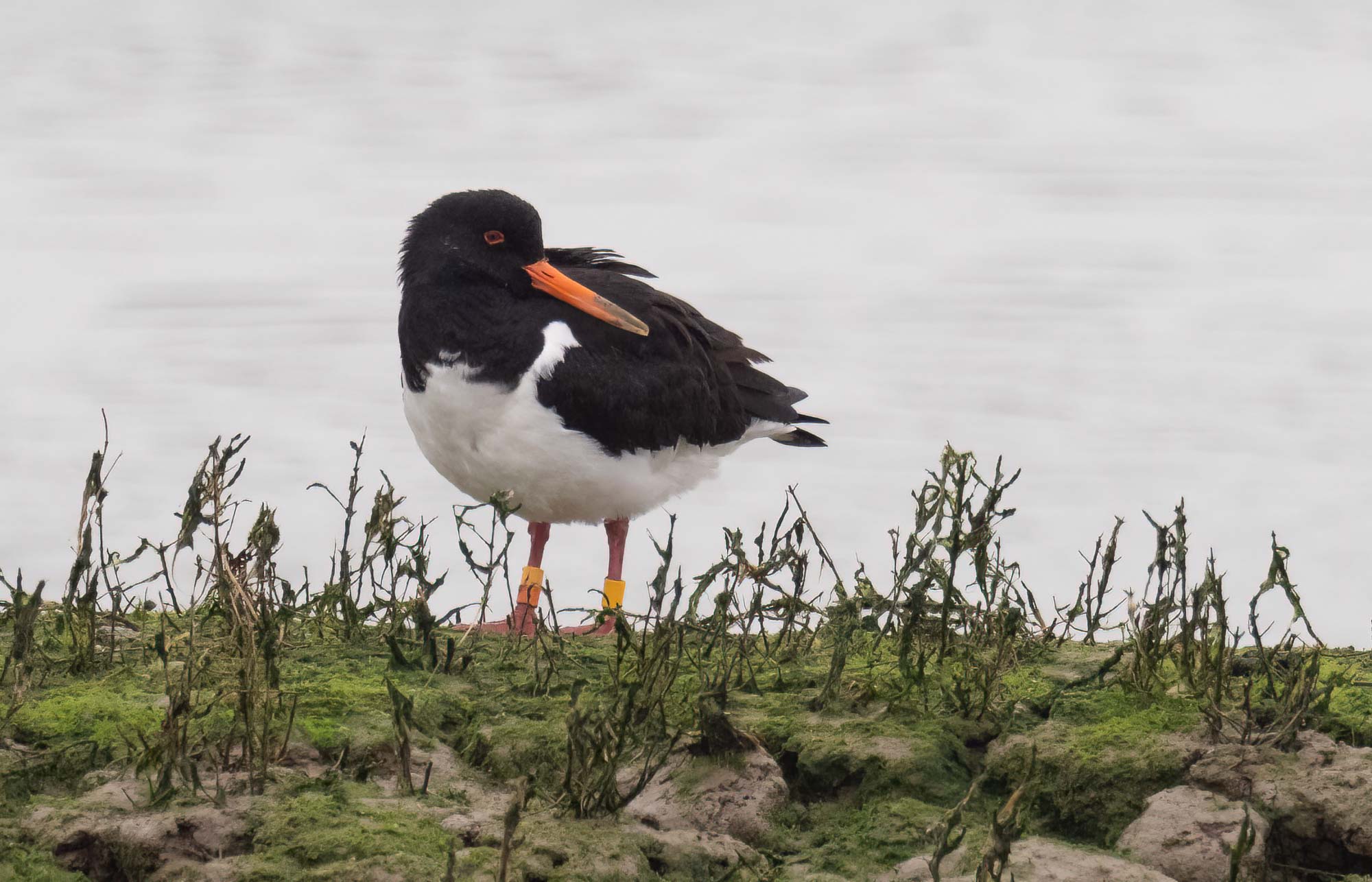
At this time of the year it’s difficult to ignore the aggressively loud display of the hunch-backed Oystercatchers. Fifteen pairs were recorded last year including seven pairs along the spit and two pairs around the Sailing Club.

Oystercatchers

At the Sailing Club a 3rd cycle gull drifted over, the darker grey mantle and large size looked interesting and so I got some photos. Although the mantle colour looked good for Yellow-legged Gull the wing pattern and scruffy head weren’t right, I think the brutish appearance and dark mantle indicates argentatus Herring Gull, the nominate race from Scandinavia.

probable argentatus Scandinavian Herring Gull

Below is a similar aged British race argenteus Herring Gull taken at the same time. You can see that the Scandinavian Herring Gull above has a darker mantle (even allowing for lighting differences) is more retarded in its moult with a black tail pattern and no grey adult feathers across the wing coverts. Angles can be deceptive but the argentatus bill also looks longer giving a more pinched out snouty expression.

argenteus British Herring Gull

A largish bird dashed into view from over the river, it was great to finally see an adult Peregrine again, over three months since my last sighting. This was a male based on his size and proportions, he flew across in front of the Sailing Club and landed on the shingle just beyond the Warden’s Hut.

male Peregrine

The 1st winter female Peregrine was still in view now on the other side of the river. She flew over and joined the male, sitting within a few yards of him. Although I didn’t see it Val confirmed that they subsequently mated at least twice on Gull Island.

Female Peregrines do occasionally breed at one year old and so there is a chance that they may be successful. Perhaps this is our original male and the new young female may be from Calshot or Keyhaven. I first saw the young female on 11th December.

Not a regular sight here so it was nice to see two separate adult Lesser Black-backed Gulls flying down the river towards Lepe. You can see that one has a darker mantle than the other demonstrating the considerable variation in mantle shade with British graellsii. The Scandinavian race intermedius is usually considerably darker than my darker bird. The paler bird may be the same individual that I saw on De L’Orne Scrape on 17th February.

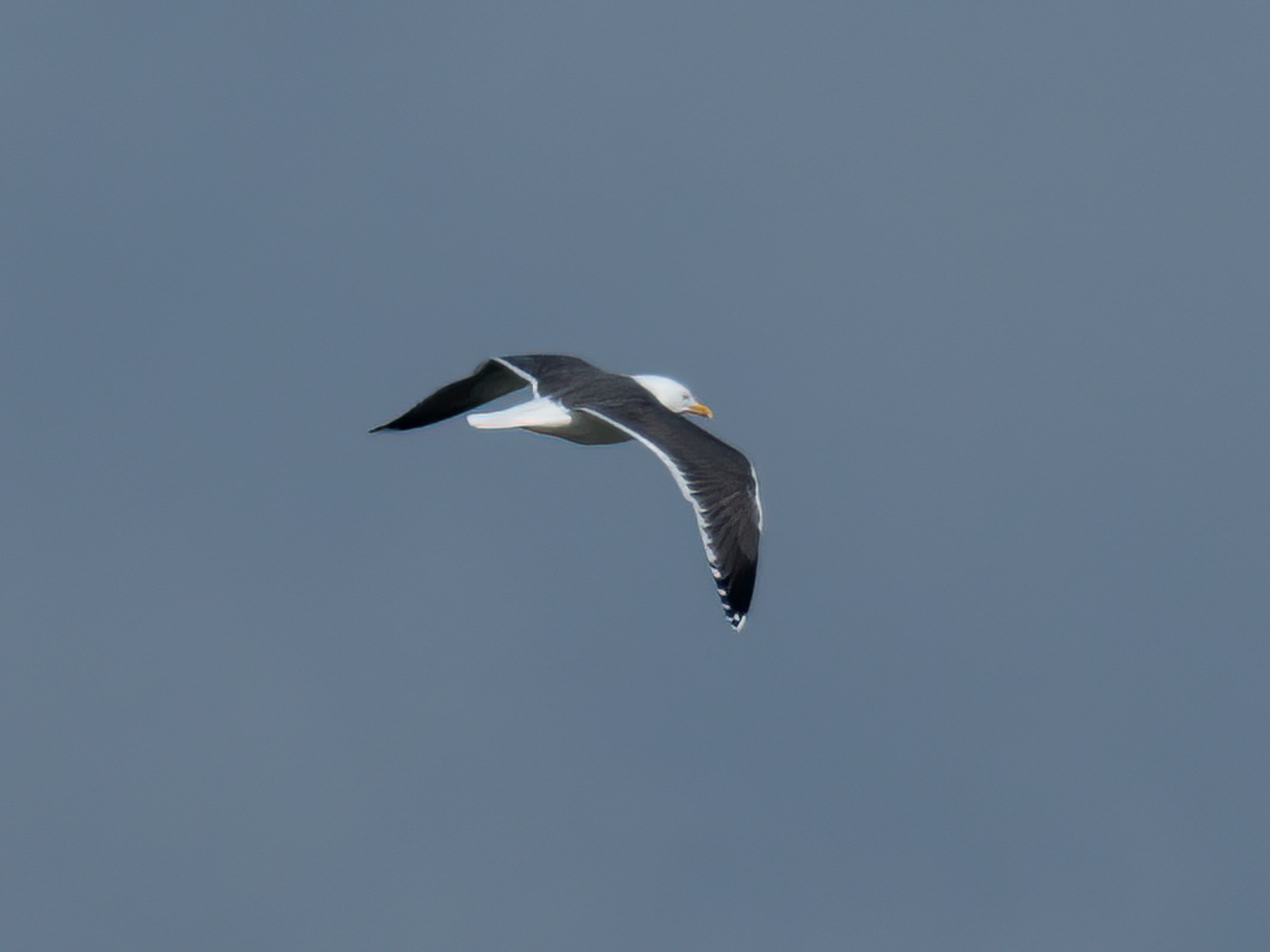
Lesser Black-backed Gull

On the walk to the hides I was surprised to see a large flock of Dark-bellied Brent Geese feeding on Droveway East and later on Droveway South. It is great to see them using these fields, there were 450 altogether. On the flooded fields the regular Greenfinch flock lifted up from the vegetation near the boardwalk bridge. There were also 11 Meadow Pipits here and my first singing Chiffchaff of the year was near the gate at Black Water.

The wintering Spotted Redshank was on the grassy fringe just in front of De L’Orne hide. I opened the window as slowly and as carefully as I could but as soon as the window angle changed the glinting of the glass flushed it sending it over to the roosting stones on the scrape. I later saw it on Gins East and given that this is a private area it may well explain why there can be long gaps in between sightings.
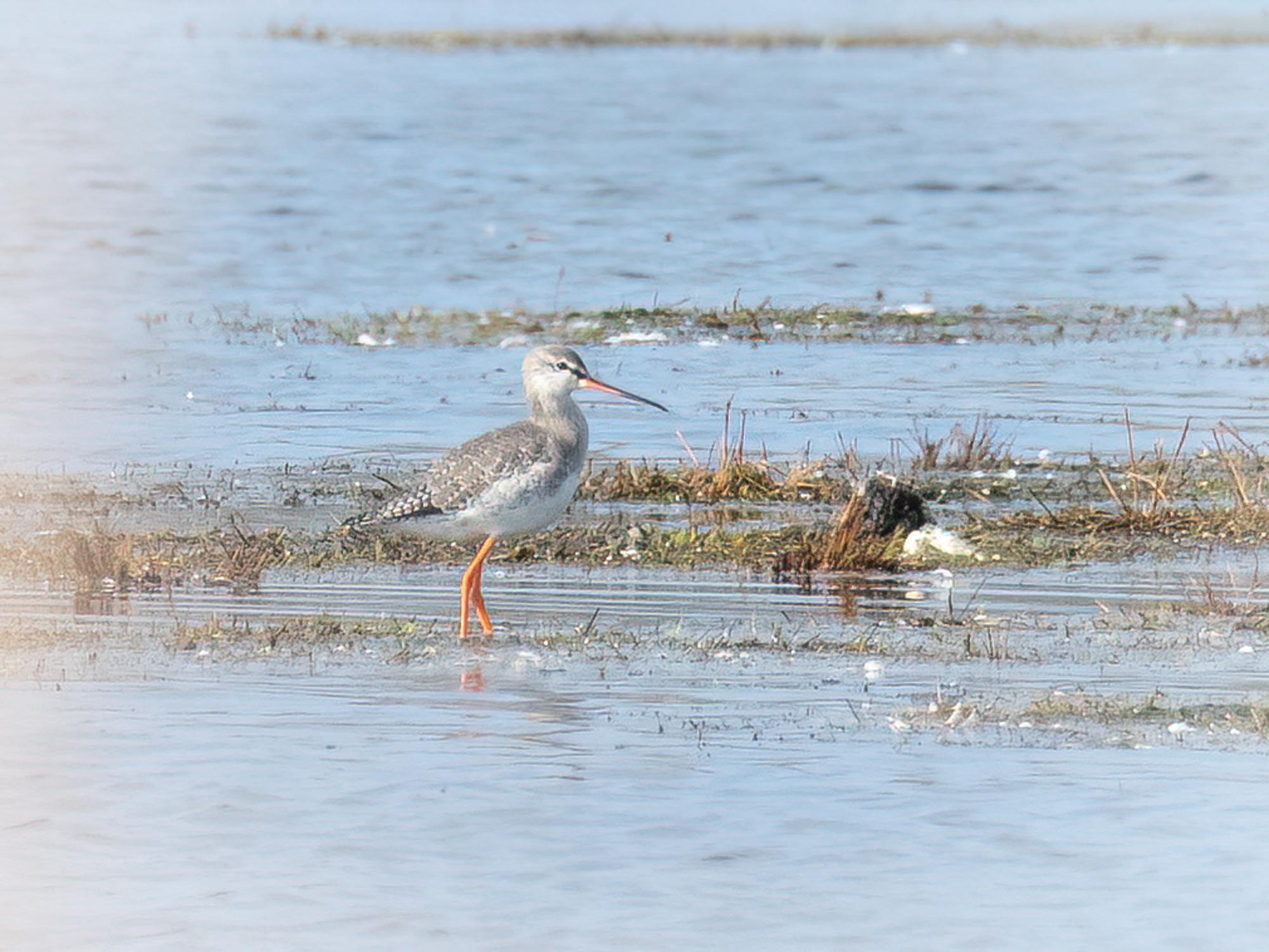
Spotted Redshank

The numbers of Avocets continues to increase with 32 now on the reserve, 26 on De L’Orne and 6 on Great Marsh. Avocet AX was on De L’Orne scrape and at least two other Avocets were mating. There were two other yellow-flagged Avocets, probably VI and a newly arrived bird but they were too distant to read. Three of the Avocets flew over to De L’Orne giving closer views.

Avocets

From the De L’Orne viewing screen I picked up a very distant Red Kite over Exbury. Ian and I later saw it on our WeBS count at Inchmery and we then had much better views as it came close over Venner. March appears to be the best month for Red Kite here with birds moving though in early spring.
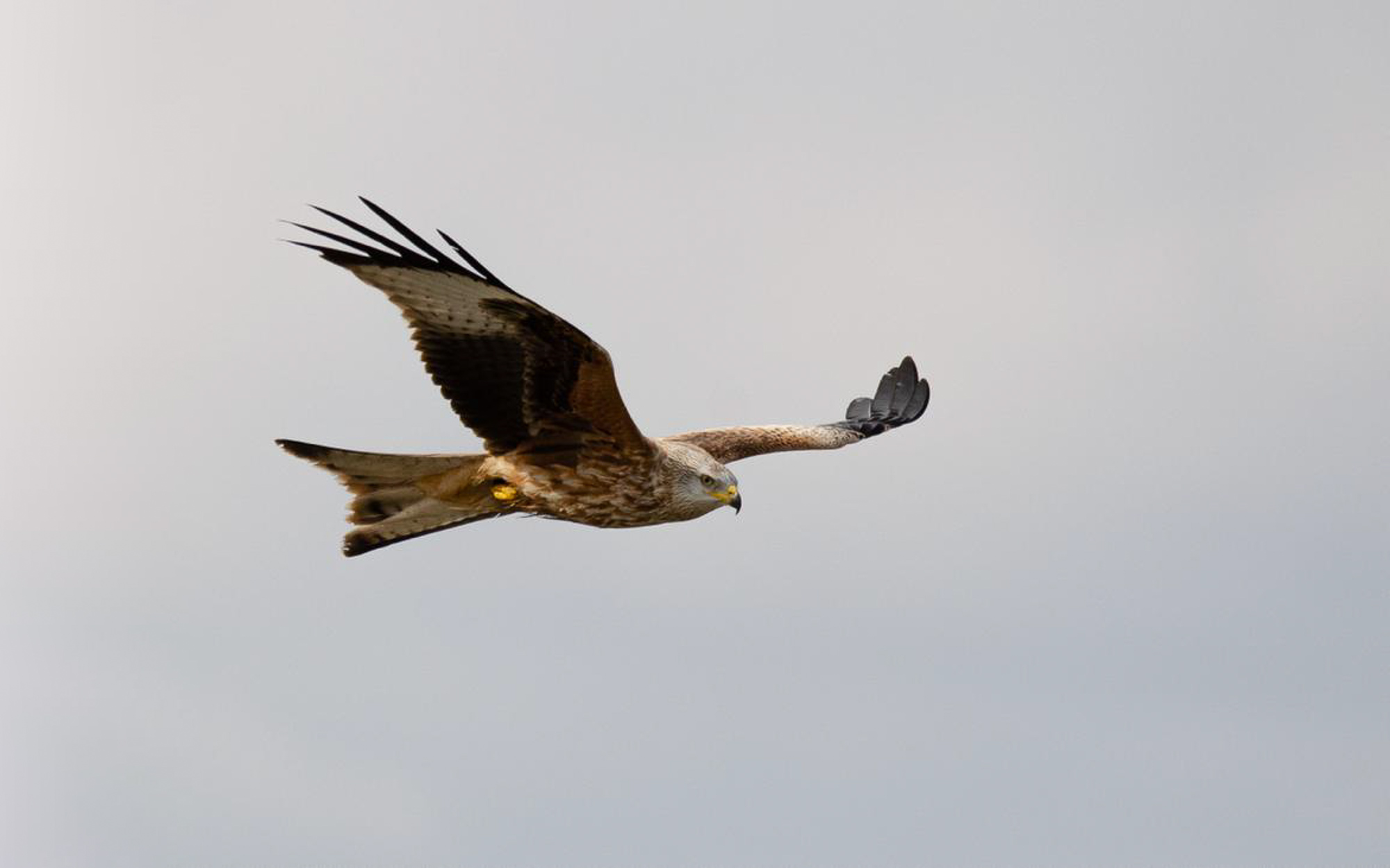
Red Kite photo by Dimitri Moore

Around Venner there were three female type Marsh Harriers. I had recently spoken to Graham about them, he has seen two female types together on several occasions here but my third bird today, a 1st year female type with a missing primary on the left wing is new. This bird can be aged confidently as a 1st winter by the buffy head (rather than whitish) and the primaries and secondaries which are clearly buff tipped.
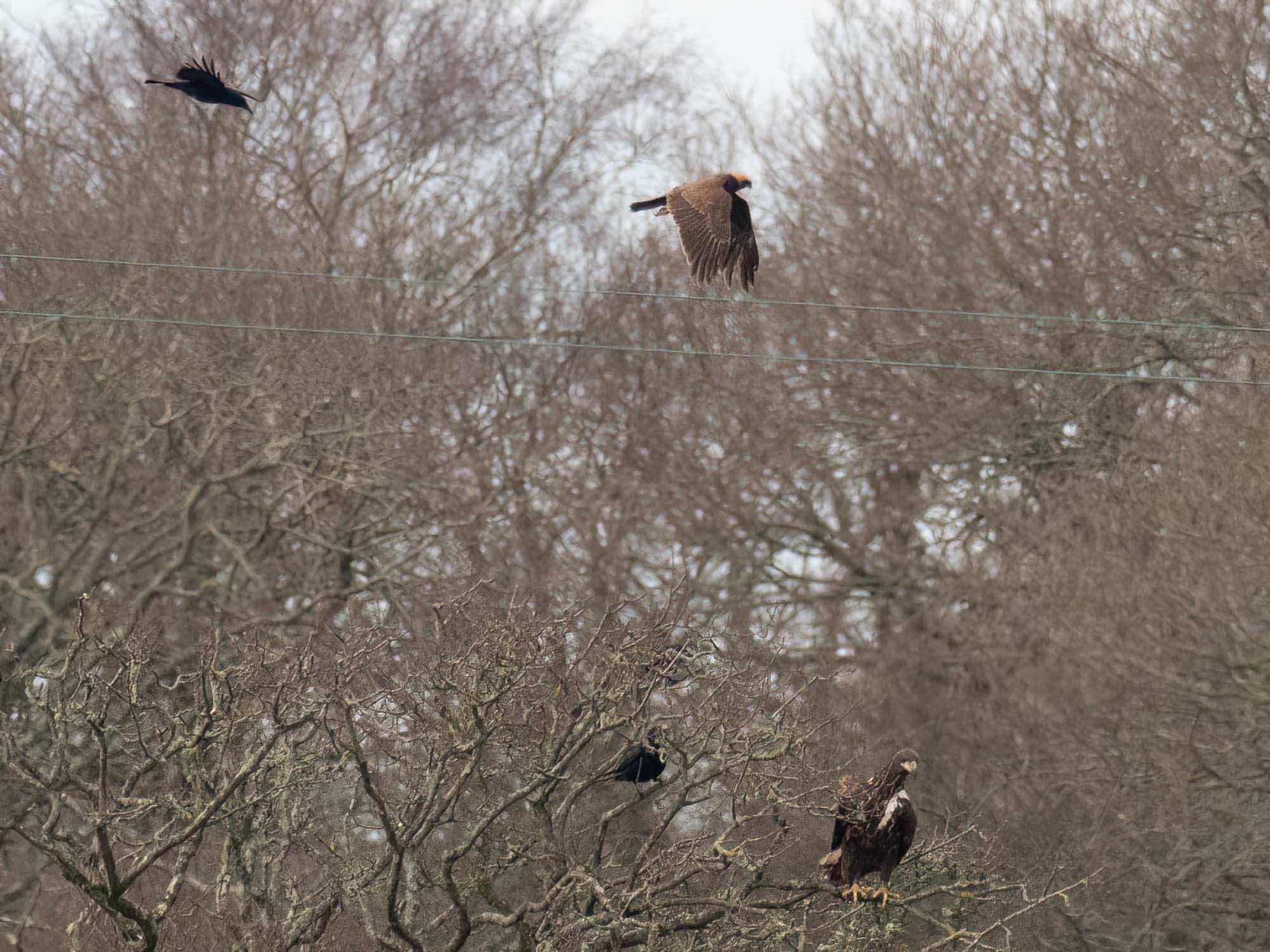
1st winter Marsh Harrier with a missing primary and White-tailed Eagle below

Graham suspects that the two other birds which he has seen regularly are a sub-adult female who has extensive creamy shoulders and a 1st winter bird. Graham saw the younger bird well yesterday and it had a dark iris suggesting that it is also a female. Today I watched this younger bird (see photo below) interacting with the older female talon grappling and mock food passing and constantly flying closely together.

1st winter female Marsh Harrier

You can see this is also a 1st winter bird but with worn feathers so that only a few of the secondaries still have buff tips, these feathers are almost a year old. The buffy head has also bleached and is nearer to the blonde of an older bird, however, an older bird would show more extensive creamy shoulders and would show different ages of feathers within the wing. Also none of the primaries or secondaries would have buff tips and the tail would be paler rufous-brown as opposed to chocolate brown.

The three year old male Marsh Harrier I have seen on several occasions may be old enough to breed but we ought to have seen evidence of food passes and nest building by now.

While in Venner Hide a pair of Roe Deer charged down Gins West Bank, dived under the barbed wire in front of us and then disappeared down the track that runs along the southern edge of the Gins. 

Roe Deer

The Dunlin didn’t seem quite so active as they’ve been on previous WeBS dates and with the wind lighter and the sun behind the clouds conditions were good for counting. Dunlin numbers were still high at 726 and almost 500 Dark-bellied Brent Geese were still on the river.

An impressive 400 Mediterranean Gulls were settled in the river mouth and on the muddy islands as the tide rose. Along with my count of 405 in late July these are the highest ever counts at Needs Ore. There was also a site high count (for me) of 38 Common Gulls which is the highest count by anyone for over three years.

On the way back from Inchmery to complete the Needs Ore part of the WeBS count we stopped briefly at the Reedy Ditch. A Goshawk appeared suddenly over Warren Flash and then drifted up higher tussling with a Carrion Crow. The wide hips, bulging secondaries, protruding cuckoo-like head and heavy powerful chest were all good features. It was actually slightly smaller than the Crow and so almost certainly the male. There is a breeding pair in Stagg’s Wood and this is the best time of year to see them especially on sunny days with a breeze.
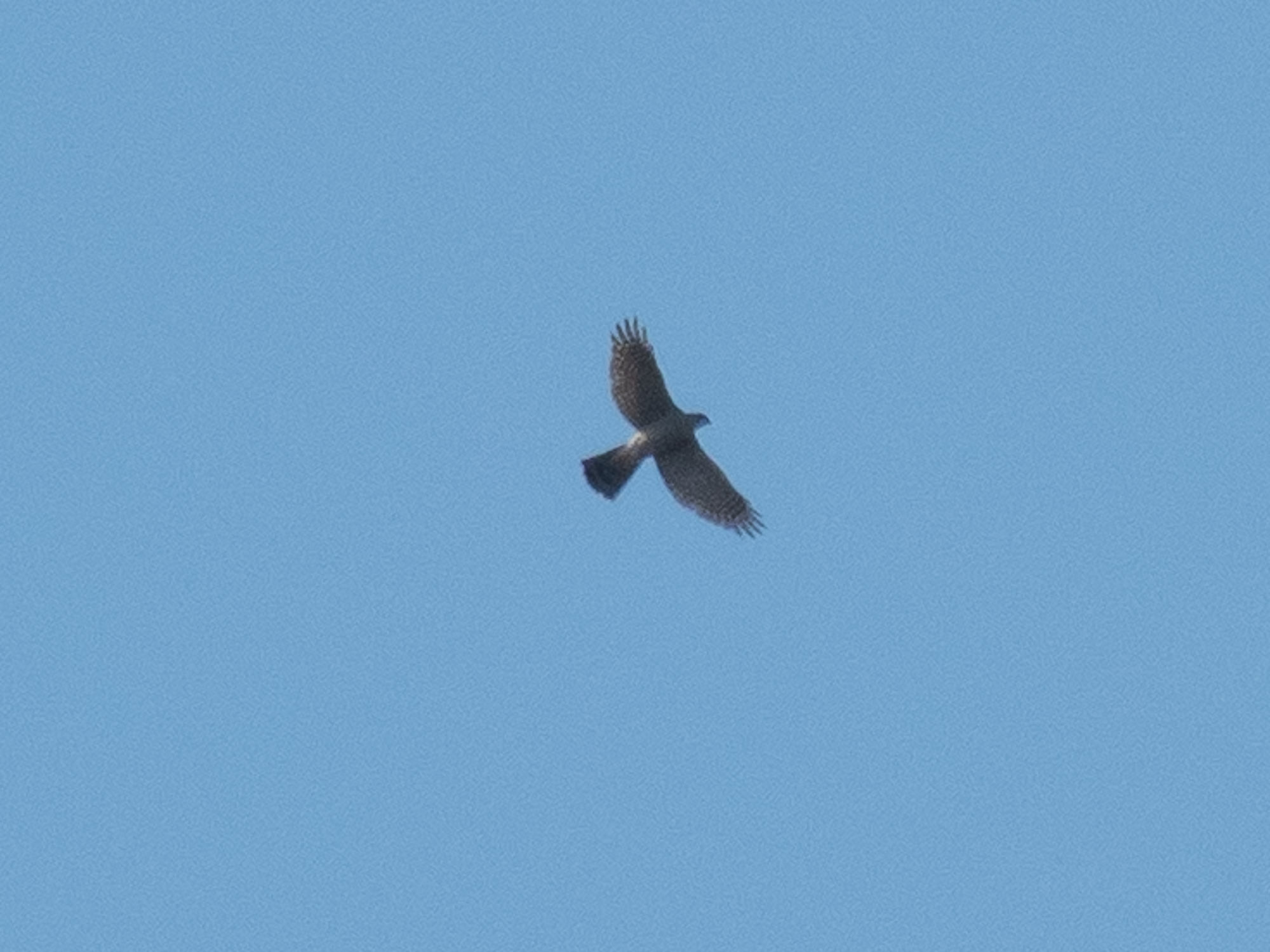
male Goshawk

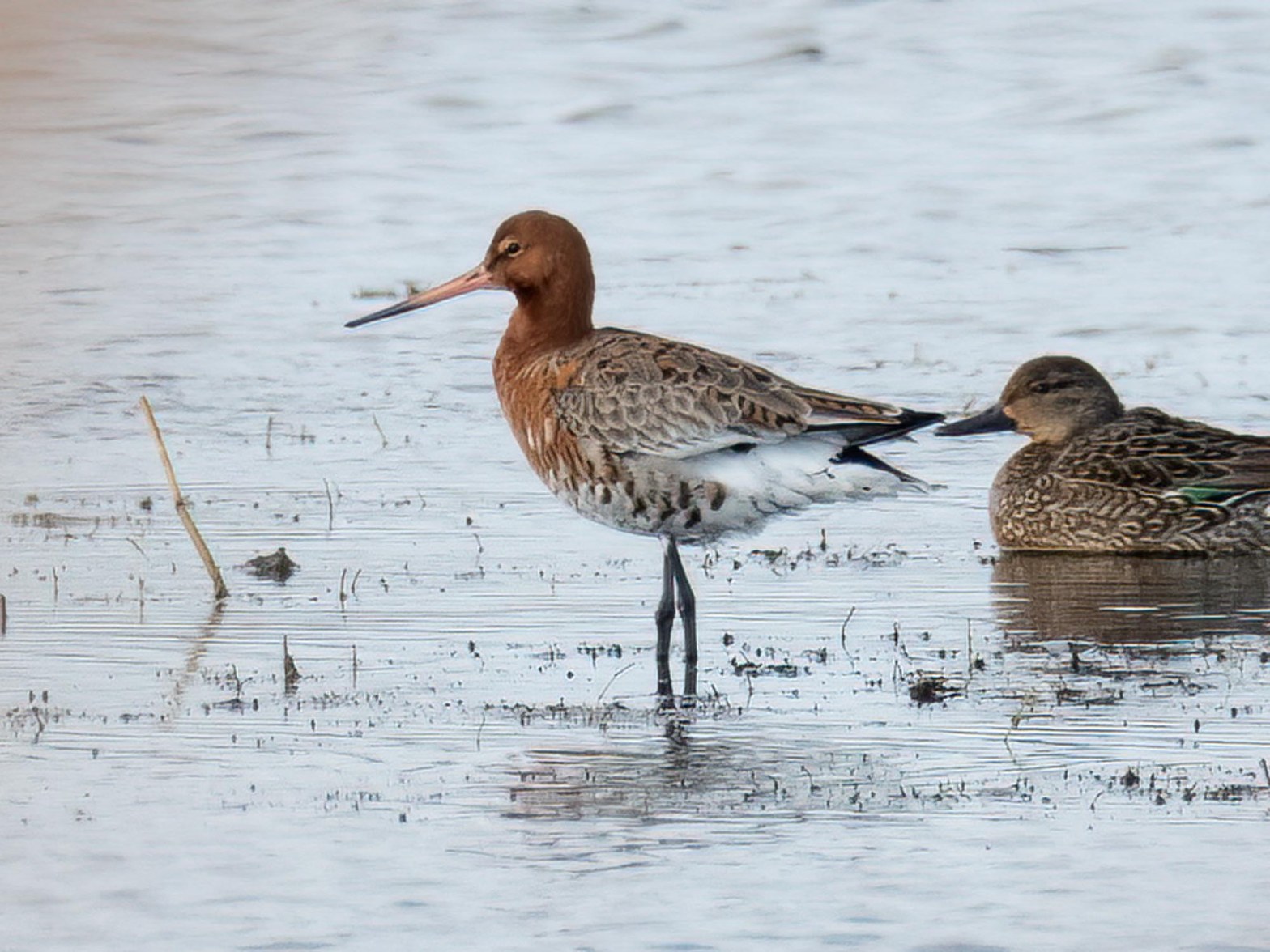
On Gins East several Black-tailed Godwit were roosting and they included a lovely summer plumaged bird. Most of the other godwit are nowhere near this advanced. The bill looks particularly short on this individual suggesting that it is a male, males are also more colourful. Black-tailed Godwits will be heading back to Iceland in the coming weeks. Some studies have suggested that Icelandic Black-tailed Godwits that winter in Portugal moult earlier than British wintering flocks.

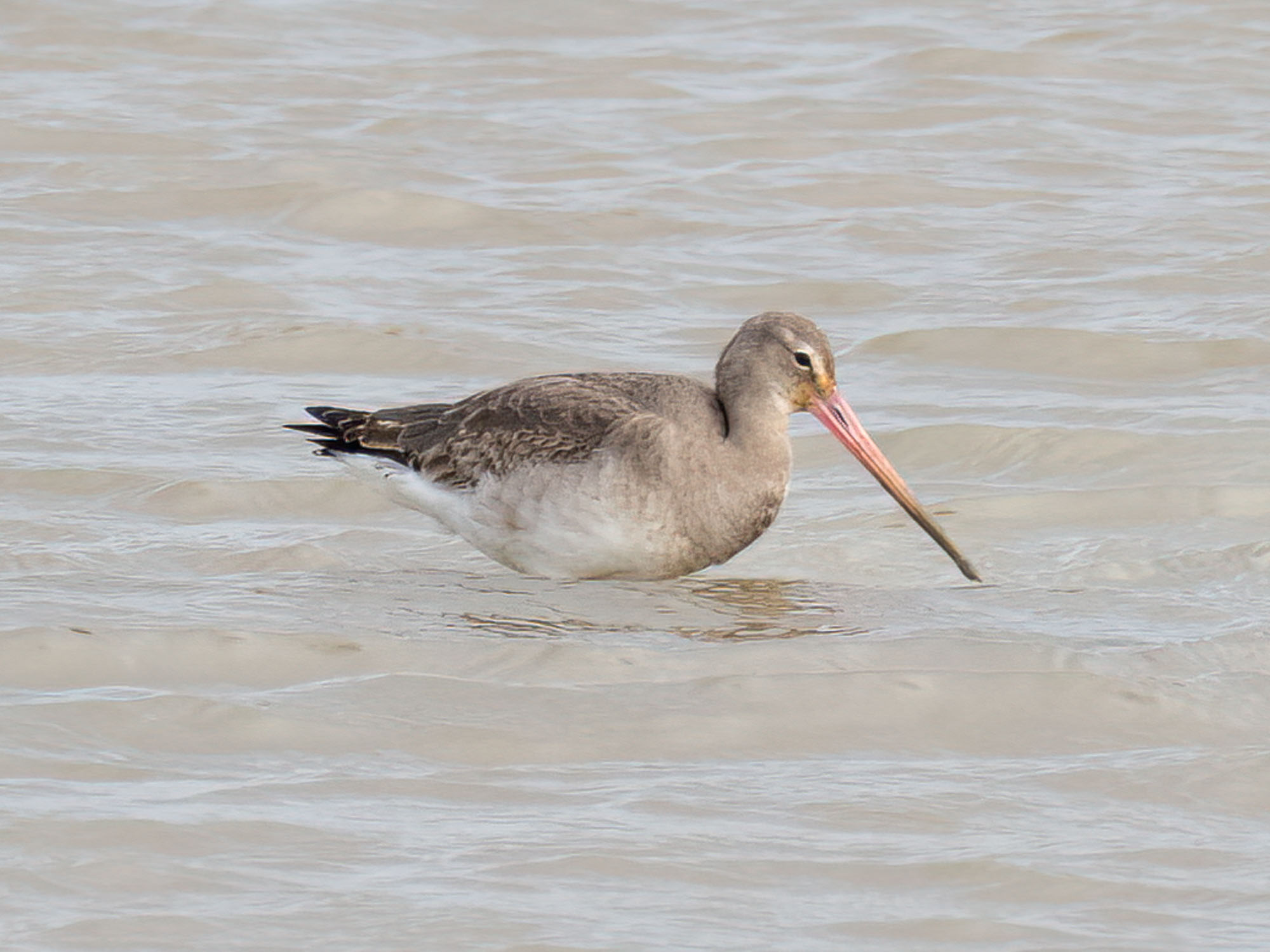
summer plumaged Black-tailed Godwit
winter plumaged Black-tailed Godwit

There was also a good count of 12 Snipe hiding together and most of the remaining Teal also seem to be here.  This is a private area but a key route on the Breeding Bird Transect which starts later this month and runs for 12 weeks. It was good to see that waders and wildfowl didn’t seem too perturbed by my presence.

Needs Ore Bat Survey 2021

Static bat recorders were set up at various places around the reserve – the Wardens Hut at Needs Ore Point, Black Water Hide, Pullen Hide, the fence line near Mary Monts Bungalow, the Viewing Gate overlooking the Flooded Fields, Shore Hide, Stagg’s Wood and Gravelly Marsh. I also set up a detector at Lepe.

More than 30,000 individual bat calls were detected during the nine month recording period (March to October). Software was used to interrogate the .wav files and initial automatic identifications were suggested by the software.

Where I have given a total of recordings for each species (e.g. Soprano pipistrelle 19,192) this is based on the automatic identifications suggested by the software. The auto ID is not 100% reliable, it’s not feasible to manually check these identifications but these auto ID totals do give a good idea of the abundance of different bat species across the reserve.

For the rarer species these automatic identifications were manually checked and discussed with the County Recorder, Nik Knight.

Eleven species of bat were recorded on the reserve including rarities Greater horseshoe bat, Barbastelle, Nathusius’ pipistrelle, Leisler’s bat and the intriguing possibility that Grey Long-eared bats are also here. Another three myotis species of bat were also recorded but are too difficult to separate on call alone.

Soprano pipistrelle

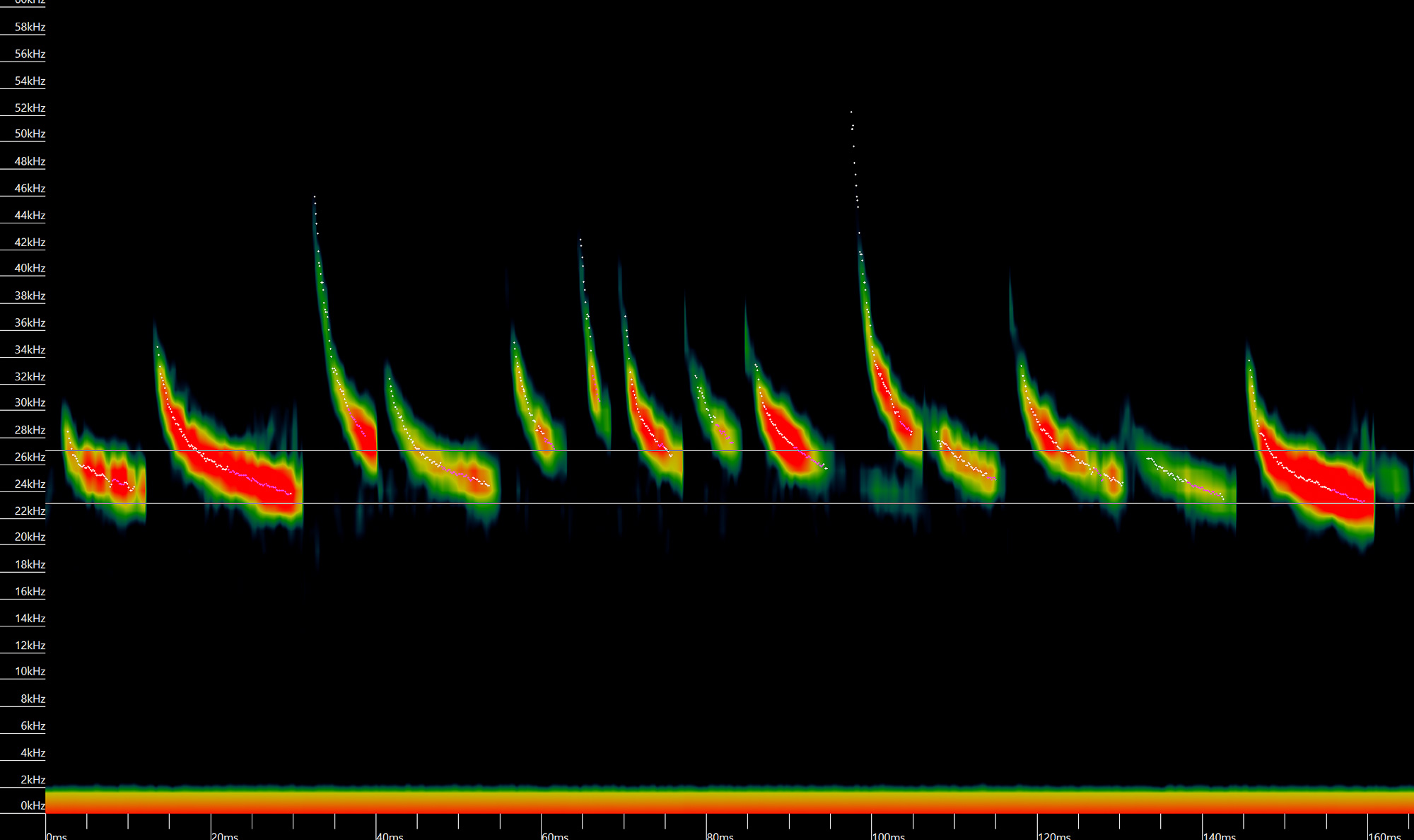
The two commonest bat species found in the UK are Common and Soprano pipistrelle. Pipistrelles appear fast and jerky in flight as they dodge about pursuing small insects which the bats catch and eat on the wing. A single pipistrelle can consume up to 3,000 insects in one night! They generally emerge from their roost around 20 minutes after sunset and fly 2-10m above ground level searching for their insect prey, which they catch and eat on the wing by ‘aerial hawking’.

Populations of pipistrelles have declined dramatically in the last few decades, partly as a result of modern agricultural practices.

Soprano pipistrelle is the commonest species of bat at Needs Ore with more than twice as many recordings (19,192) as the Common pipistrelle (7,443). This may well be because Soprano pipistrelles prefer wetland habitats including lakes and rivers as well as woodland edges, tree lines and hedgerows.

Soprano pipistrelles were recorded regularly from all of the detectors.

Common and Soprano pipistrelle were only identified as separate species in the 1990s. With a bat detector the peak intensity of the call is around 55kHz for Soprano pipistrelle and 45kHz for Common pipistrelle.

Soprano pipistrelle, frequency line shown at 55kHz

Common pipistrelle

The second most common species of bat at Needs Ore with 7,443 recordings spread across all of the bat detectors.  

Compared to the Soprano pipistrelle they are more generalist feeders found in a wide range of habitats comprising woodland, hedgerows, grassland and farmland.

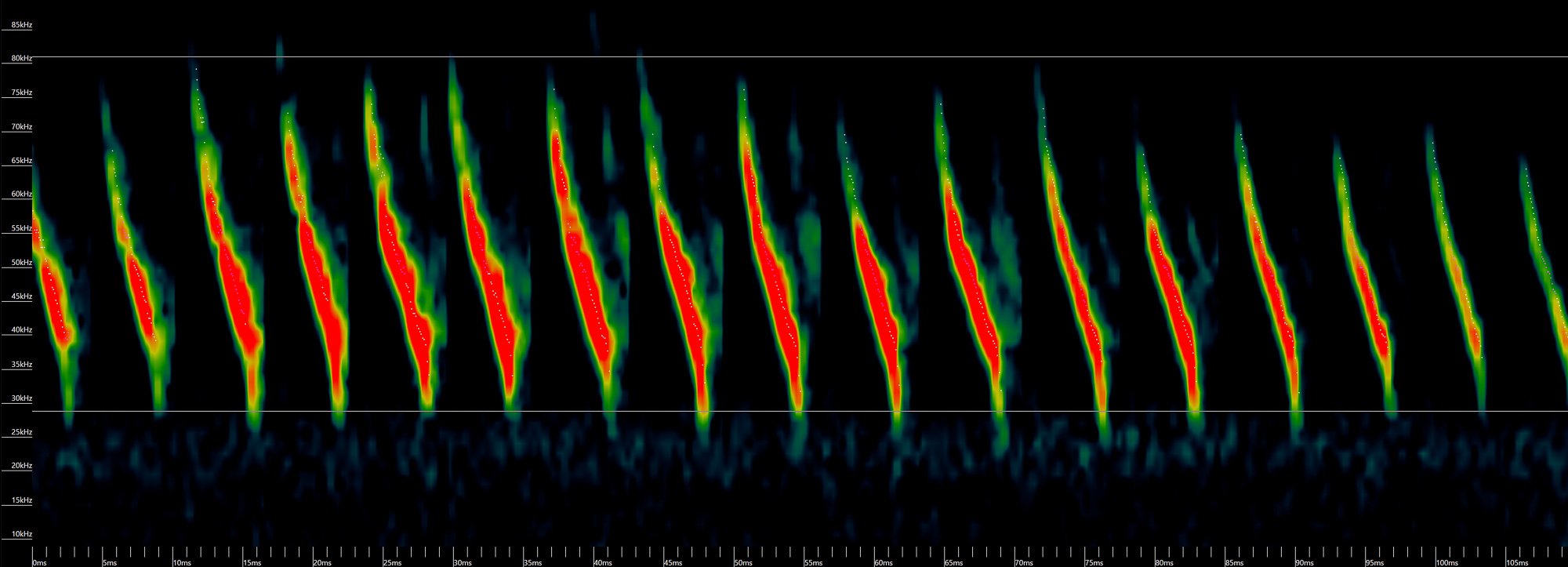
The peak intensity of the call is around 45kHz.

Common pipistrelle, frequency line shown at 45kHz

Nathusius’ pipistrelle

Nathusius’ pipistrelle is a rare bat in the UK.

It is a migratory species with the first confirmed record of Nathusius’ pipistrelle at Needs Ore flying past the Warden’s Hut on 9th April, six minutes later the same bat was recorded off the car park at Lepe, that’s 28kph for the 3km. They migrate back to their breeding areas in Latvia using this stretch of the coastline.

There were 30 recordings with most during the peak migration period of August to October (bats heading west) and with most recordings from the Warden’s Hut at Needs Ore Point reflecting their migration route along the coastline.

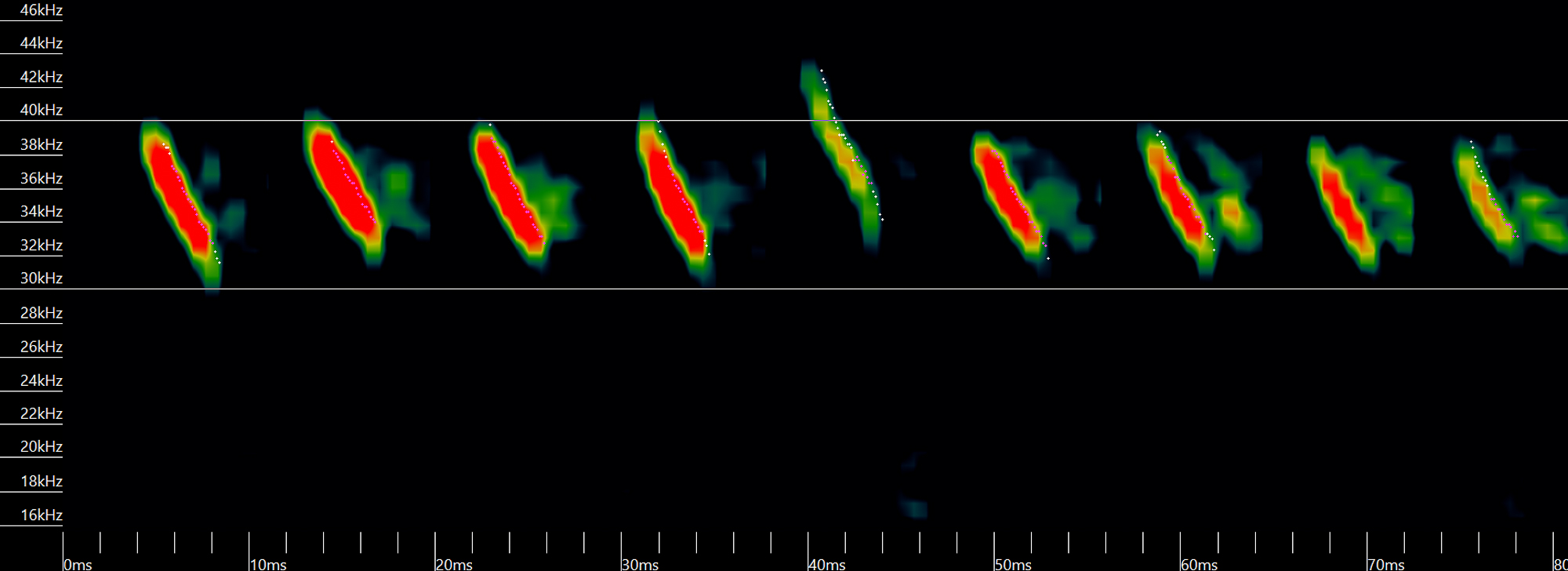
Echolocation calls of Nathusius’ pipistrelle are similar to those of the other pipistrelles, however, the peak intensity of the call is lower than the other two pipistrelle species (see above) at about 38kHz.

Nathusius’ pipistrelle, frequency line shown at 38kHz

Noctule

The Noctule is the largest British species and is usually the first bat to appear in the evening, sometimes even before sunset. They have a characteristic powerful, direct flight on narrow pointed wings. They fly in the open, often well above tree-top level, with repeated steep dives when chasing insects. Noctule bats can fly at 50kph.

The Noctule is still a relatively widespread species in much of England and Wales but has declined owing to modern intensive agricultural practices resulting in the loss of suitable feeding habitat such as permanent pasture and woodland edge/hedgerows.

The recording software suggested 1,606 recordings during the survey period making it the third most common species at Needs Ore. Noctules were regularly recorded from all of the detectors.

They echo locate with a characteristic alternating of two call types with peak frequencies of 24kHz and 19kHz.

Noctule

Serotine

Closely related to the Noctule the Serotine is one of Britain’s largest bat species and usually one of the first to appear in the evening, often emerging in good light. The serotine is far less common than the Noctule. 27 recordings were made mainly from around Black Water Hide and Shore Hide.

The spectrogram below was made near the Viewing Gate and in open situations like this the peak frequency is around 25kHz, unlike the Noctule it does not produce alternating calls of two frequencies.

Serotine, frequency line shown at 25kHz

Leisler’s bat

Very similar to Noctule but slightly smaller. Rare in the UK.

There were 455 Leisler’s bat recordings made during the survey with the bulk of the recordings from around Black Water Hide. This number significantly over estimates the population here as they are very difficult to separate from Noctule and Serotine by call and a good number of the auto identifications are probably incorrect and likely refer to Noctules.

Nevertheless it is possible to confirm Leisler’s bat with a long enough recording to show a clear alternation between two call types peaking at 27kHz and 23kHz, which are above those for Noctule.

Leisler’s bat, frequency lines shown at 27kHz and 23kHz

Myotis species

The myotis genus of bats are very difficult to identify in the field. While it is possible to identify Daubenton’s bats and Natterer’s bats from echo location calls (see the next two species) it is more difficult to identify other myotis bats. There were many recordings which were auto identified as Bechstein’s, Whiskered or Brandt’s bats but these are best recorded as myotis species given how difficult they are to separate.

Daubenton’s bat

Also known as the water bat it has a steady flight, often within a few centimetres of the water surface where they take insects, sometimes directly from the water surface using their large feet as a scoop. Daubenton’s bat is fairly widespread up to northern Scotland.

There were 352 recordings making it the fourth most abundant bat on the reserve although there is the distinct possibility that some of these records may be other myotis bats. A positive identification of Daubenton’s is best confirmed by seeing the bat flying low over the water catching their insect prey. A classic echolocation includes a rapidly descending frequency modulation sweep from 81kHz to 29kHz.

Records were mainly from the water bodies at Black Water and Pullen.

Daubenton’s bat, frequency lines shown at 29kHz and 81kHz

Natterer’s bat

Natterer’s bats have a slow to medium flight, sometimes over water, but it is more often associated with woodland habitats. Much of the prey is taken from foliage and includes many flightless or day-flying insects. Sometimes larger prey is taken to a feeding perch

Natterer’s bat is one of the myotis bats and so identification needs to be made with caution. Natterer’s bats can usually be confirmed by the very low end frequency down to 20kHz and the high start frequency of 100kHz plus.

74 Natterer’s bat recordings were made from all areas of the reserve.

Natterer’s bat, frequency line shown at 20kHz

Barbastelle

The barbastelle is very rare, found in southern and central England and Wales. Very few breeding sites are currently known in the UK. They prefer pastoral landscapes with deciduous woodland, wet meadows and water bodies, such as woodland streams and rivers.

The first record for Needs Ore was an individual recorded from Pullen Hide on 26th June. The same individual (or possibly a small number of other Barbastelles) were subsequently recorded along Warren Lane in the early autumn with the main concentration being around Shore Hide. 

The spectrogram shows the frequency modulation sweep from 44kHz to 29kHz in around 4.5ms. The records have been confirmed by the County Recorder.

Barbastelle, frequency lines shown at 30kHz and 40kHz

Greater horseshoe bat

The highlight of the year was a Greater horseshoe bat recording flying past the Warden’s Hut at 11:30pm on the 19th September. This is a significant record for Hampshire and has been confirmed by the County Recorder.

The Greater horseshoe bat has shown a marked decline and it is rare in Britain confined to the South West and South Wales. It is estimated that the number of Greater horseshoe bats has declined by over 90% in the last 100 years.

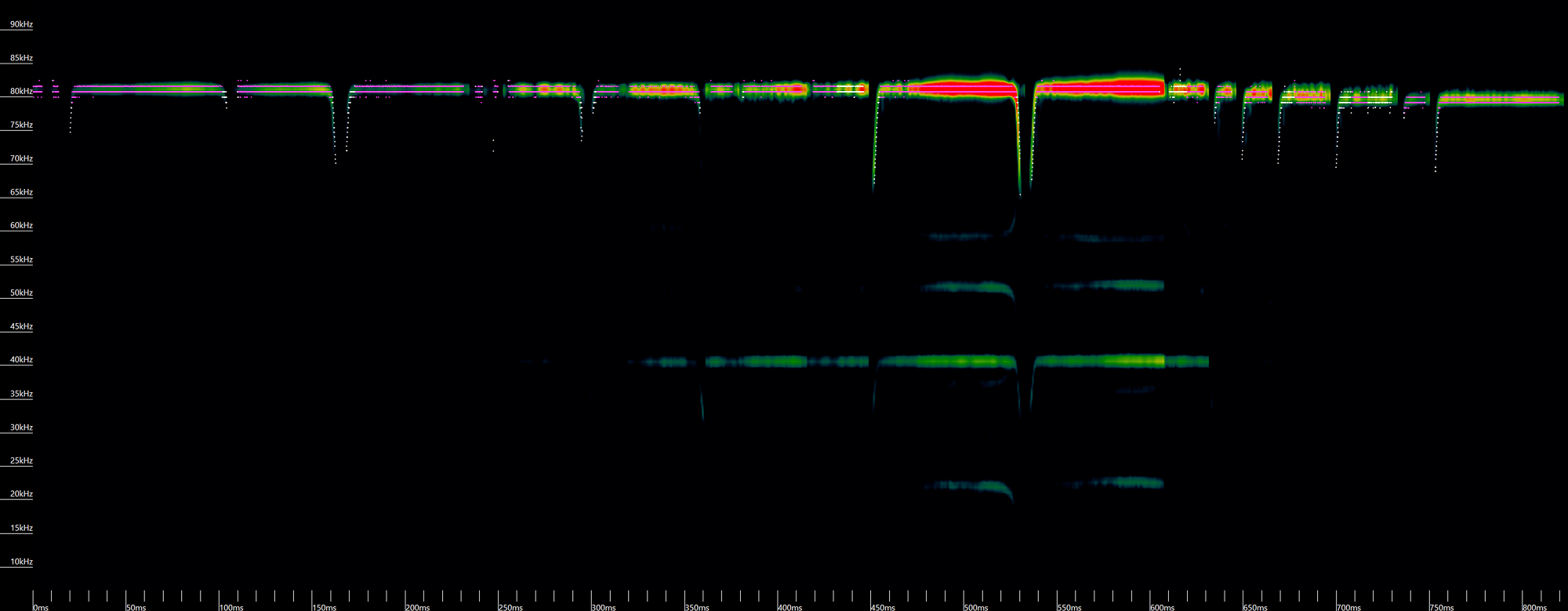
The echo location is pretty unmistakable with calls at around 85kHz with a characteristic hoop shape and similar shaped harmonics at half the frequency, 42.5kHz.

Greater horseshoe bat

Brown long-eared bat

Brown long-eared bats are gleaners, often flying slowly amongst foliage, picking insects off leaves and bark. They are known as ‘whispering bats’ because their echolocation sounds are very quiet. The difficulty in picking up these quiet echolocation calls may account for the relatively low number of recordings (49). You typically need to be within 5m of the bat to get anything useable.

Brown long-eared bats were recorded from all areas of the reserve but less so from the more open areas.

Their echolocation calls include two harmonics, the first a sweep from 55kHz to 24kHz and the second a sweep down to around 51kHz.

Brown long-eared bat, frequency line shown at 24kHz and 51kHz

possible Grey long-eared bat

Perhaps the most intriguing record is the possibility that we have Grey long-eared bats at Needs Ore. This species is very rare found only in a few places in southern England.

There were 40 recordings which the auto identification software recorded as Grey long-eared bats. They are very difficult to distinguish from the more common Brown long-eared bat and no doubt most of these recordings will be the commoner species. However, several of my recordings were considered by others to be probable Grey long-eared bats, including the recording below, but given the rarity best recorded as a plecotus species.

Their echolocation calls are slightly lower than Brown long-eared bat (although there is overlap) and also include two harmonics, the first a sweep from 45kHz to 21kHz and the second a sweep down to around 44kHz.

Grey long-eared bat, frequency line shown at 21kHz and 44kHz

The County Recorder has commented that as “Grey long-eared bats are so rare we have to be very cautious. However, we have DNA evidence from droppings recovered from roosts near Lepe so it is possible. Over the years we have had 6 verified records of GLE from the south of the New Forest from Ringwood to Lepe, although two of those were the same ringed bat taken into care on dates 5 years apart!”

If I can build up a substantial database of likely Grey long-eared bat calls then the County Recorder has said that he may commission some trapping to collect DNA, make in the hand measurements or to collect droppings if they can be found.

Chris Button, Natural England Voluntary Warden February 2022

Tuesday 1st March 2022

A day when I braved the drizzle. Arriving at 8am I finally succumbed to hopelessly damp optics at 2pm.

Ian had seen the returning Oystercatcher near the Warden’s Hut yesterday and so I decided to head to the Sailing Club first. The Oystercatcher was in exactly the same spot as I had seen it last year on an island in the Old Spit Channel. The rings are the same other than I couldn’t see the yellow ring on the right tibia. Maybe it was caught up in the feathers or possibly lost altogether since I saw it last June. It was ringed as an adult (not a chick or a 1st summer bird) in 1999 and so is at least 25 years old.

25 year old Oystercatcher

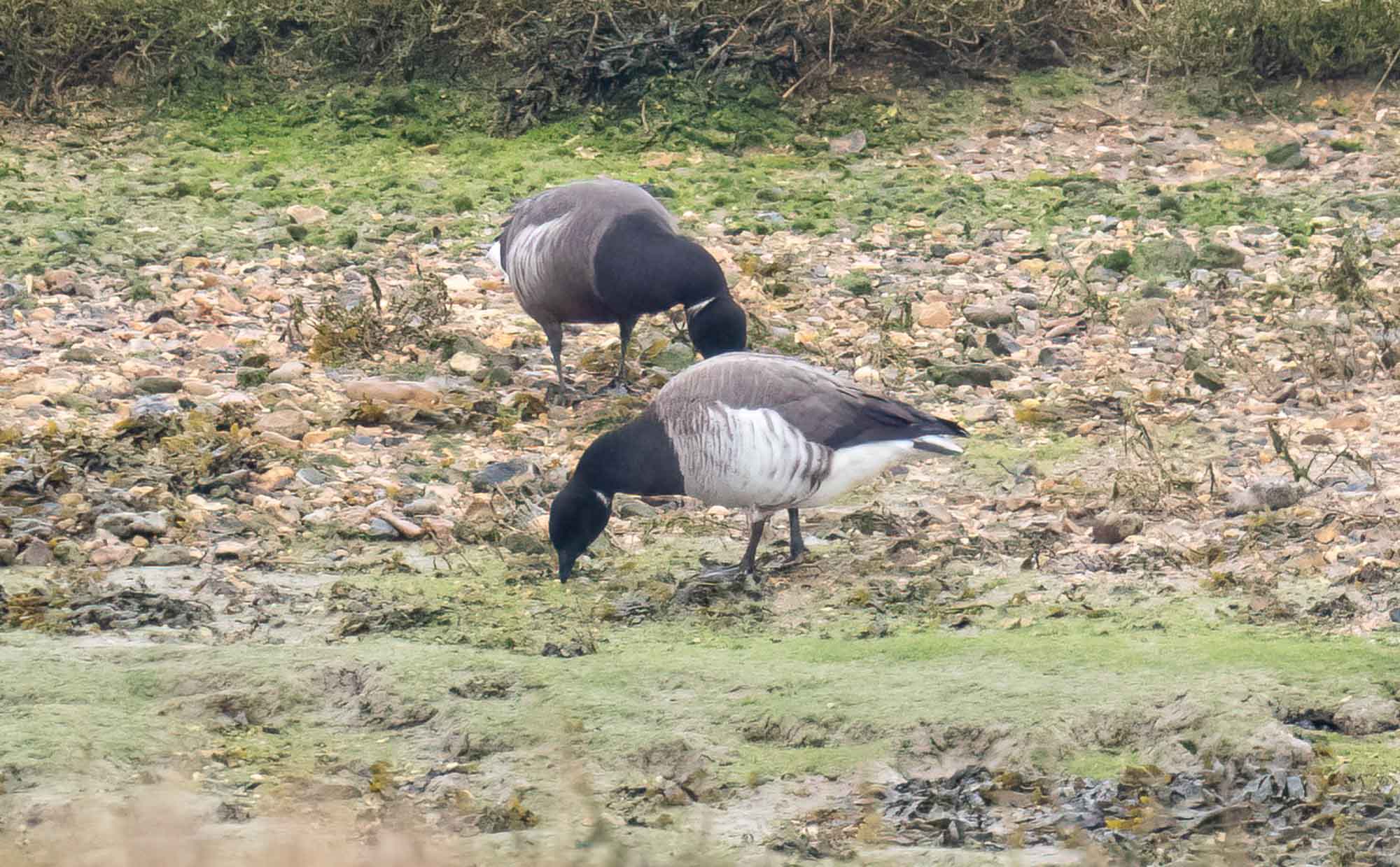
On the far end of Gull Island the 1st year Peregrine was surveying the river. I used the Warden’s Hut as a hide and was able to get closer to the Dark-bellied Brent Geese, they were feeding on the muddy inland edge of the spit and I was pleased to see that the Pale-bellied Brent Goose was amongst them. 

Pale-bellied Brent Goose

It was getting close to high tide and on the 17th Feb the spit opposite the cottages had been packed full of roosting waders. High tide was a similar height today but the spit was empty and the water level seemed much lower. I did ask the Hydrographic Office for an explanation but their detailed and helpful response left me really appreciating just how complex tidal prediction is. Local conditions mean that a tidal prediction for Buckler’s Hard or Stansore Point can be significantly off by the time you get to Warren Shore. 

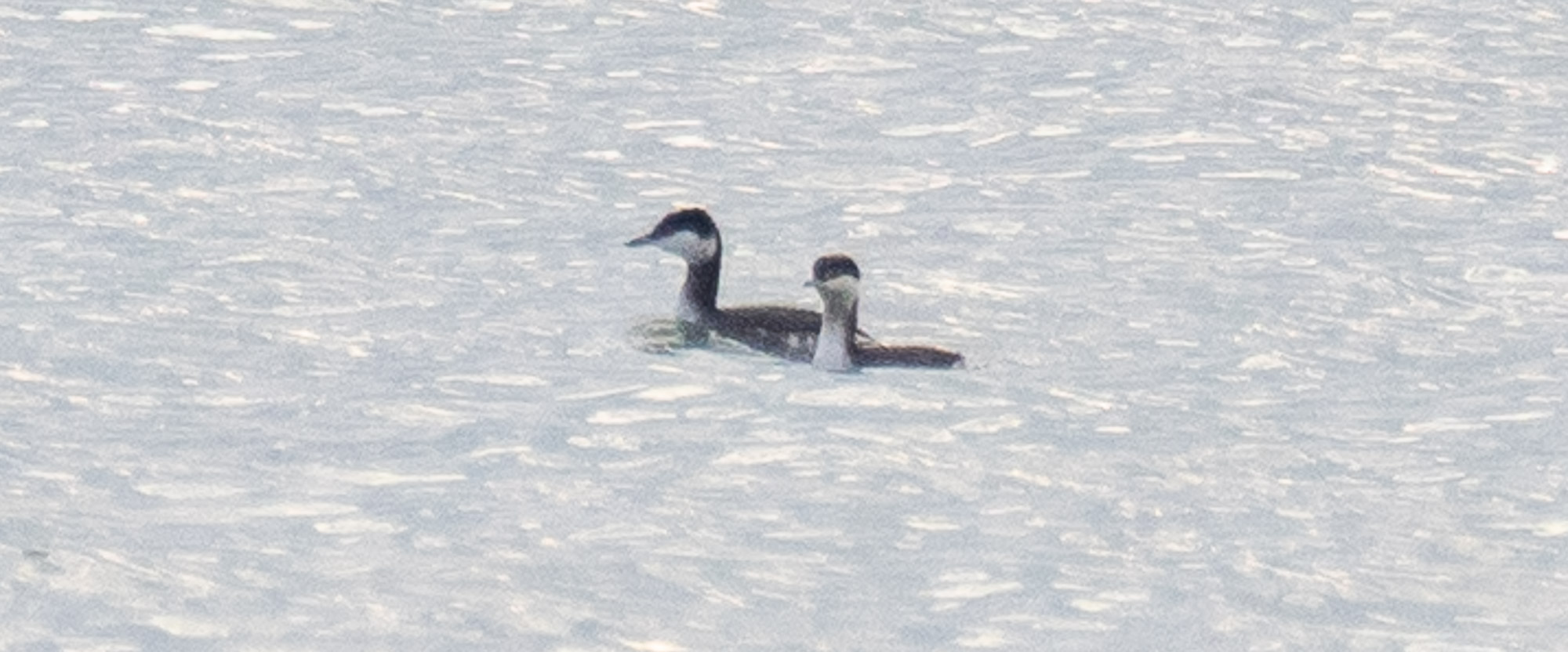
From the Warden’s Hut I picked up the two Slavonian Grebes on the sea and soon afterwards another two were also drifting west on the falling tide. On the river there were at least six Great Crested Grebes clearly paired up now and two of them were bill wagging in the preliminary part of their courtship dance.

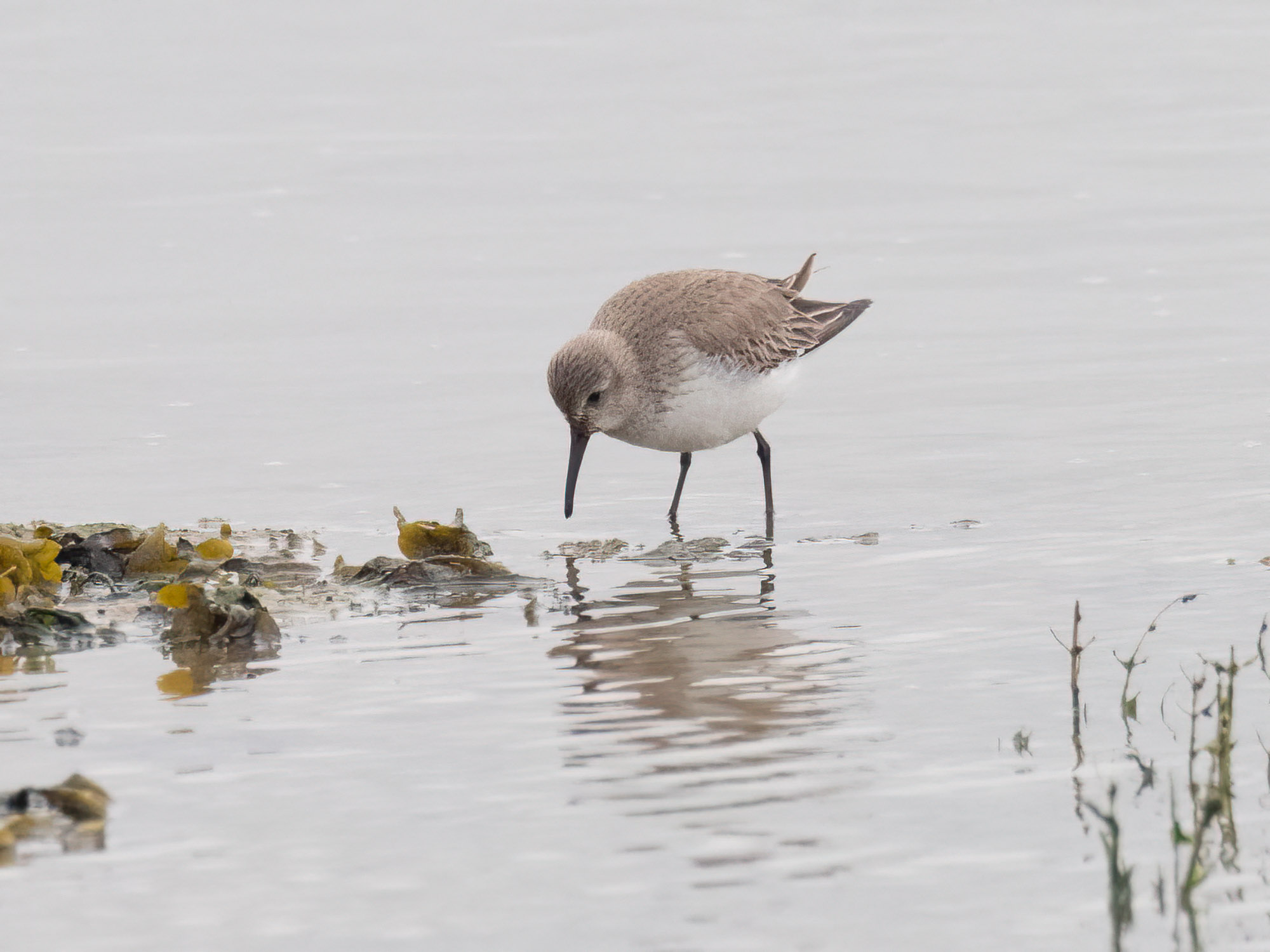
A small group of Dunlin landed close by. The race that winters around the UK is Calidris alpina alpina and they go back to Norway to breed.

Dunlin

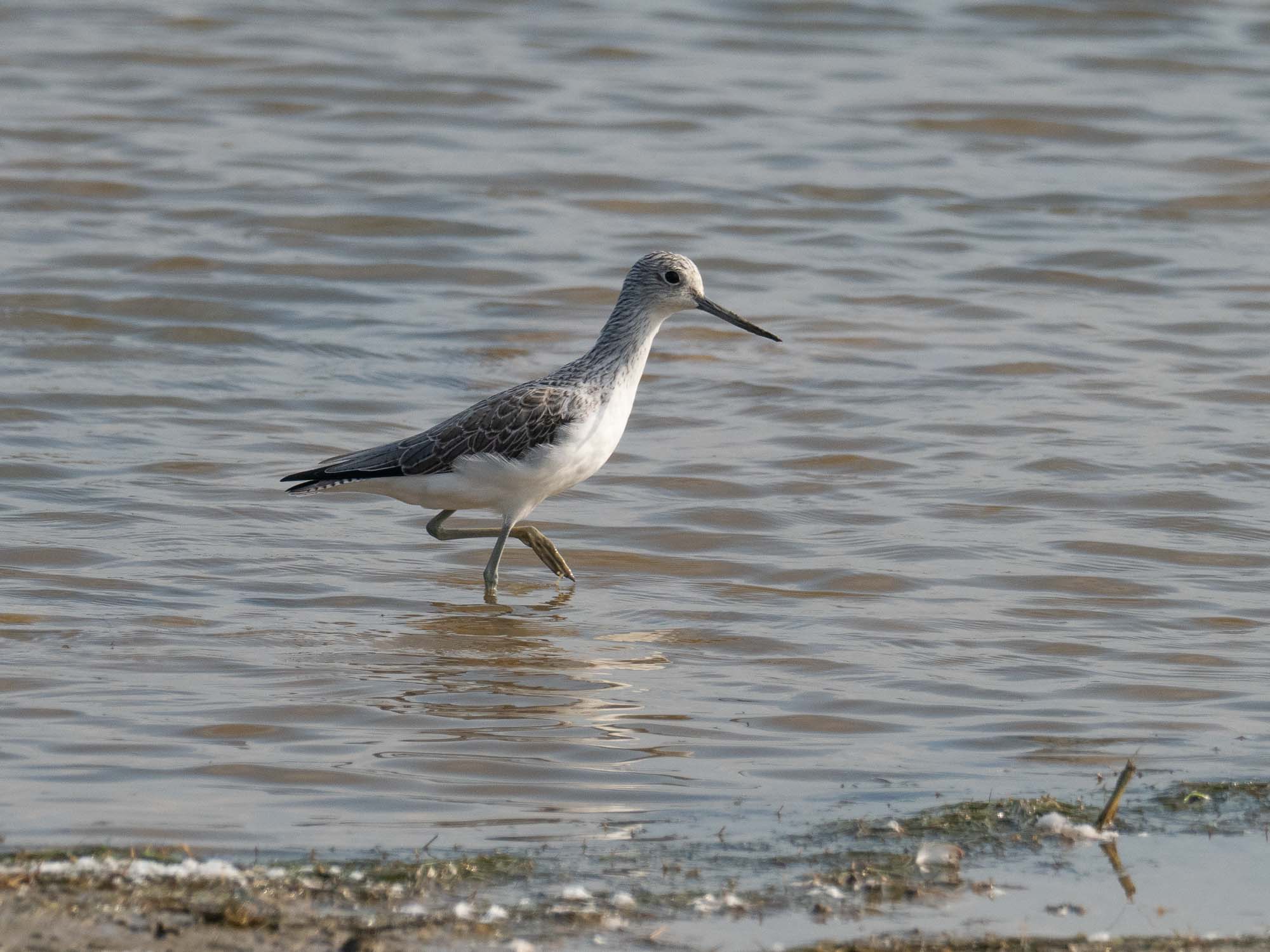
On De L’Orne a Kingfisher was sat at the back of the lagoon and there were 2 Greenshank on the Scrape. Greenshank that leave before mid-April are usually heading to Scotland to breed and those that leave in late April or early May are usually heading to Scandinavia or further east.

Greenshank

Having said that, in 2021 it was impossible to tell when the Greenshank left as I recorded a single Greenshank in every week of the year and so there didn’t appear to be a gap after which birds left for Scotland/further east and before returning birds appeared in the early autumn. I believe that Greenshank return north to breed in their first summer and so it seems odd that we should have had a Greenshank on De L’Orne in every week during May to July.

Also on the scrape the Avon Valley colour-ringed Redshank was still present and there were now 23 Avocets.

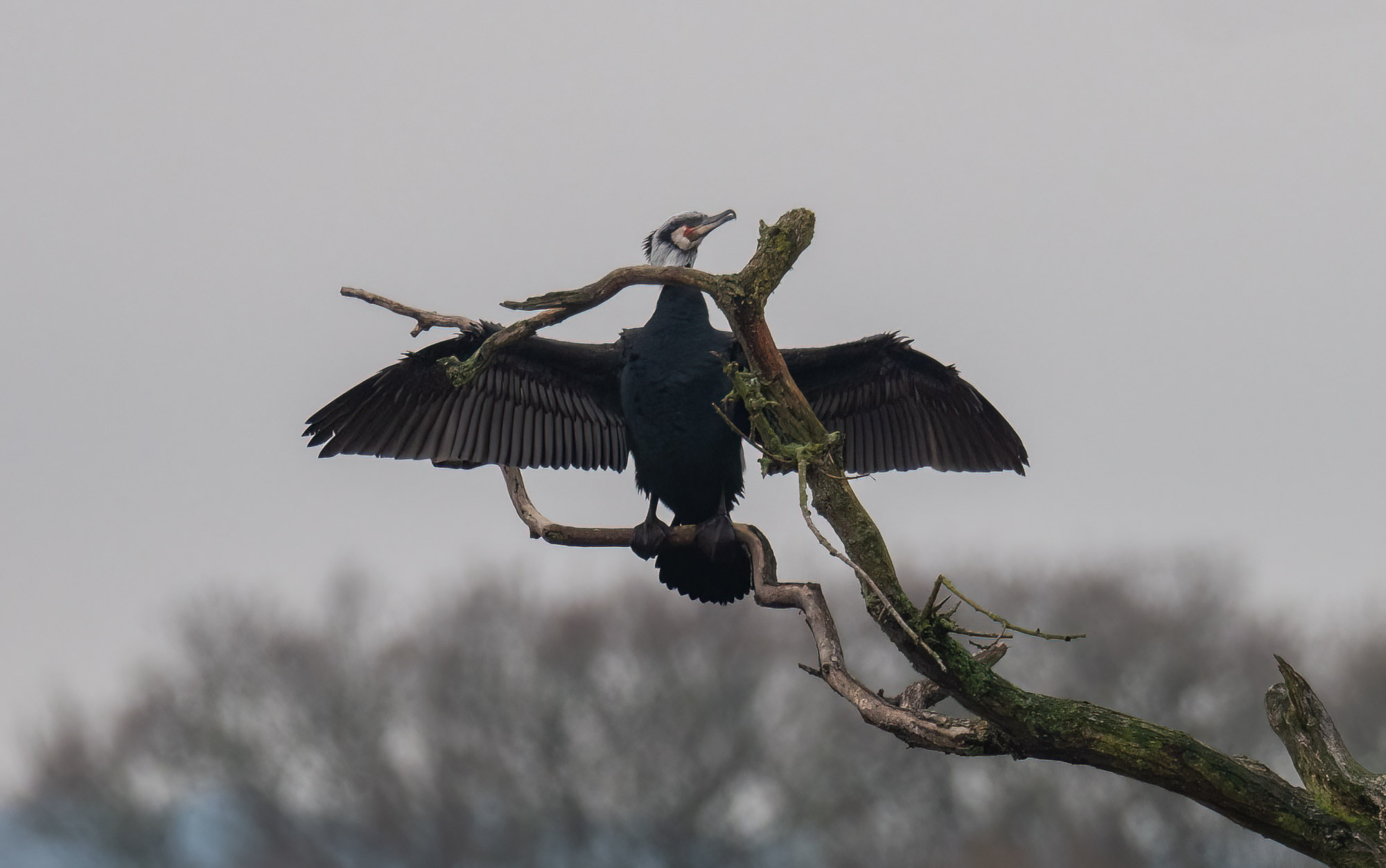
From Venner Hide I counted 62 Black-tailed Godwit on Wigeon Fields and a breeding plumage Cormorant was wing drying on the Island. The gular angle looks close to 90 degrees and with the extensively white head I wondered if this may be a sinensis race Cormorant. Given the overlap on this feature, however, it’s probably best to wait for an individual with a gular angle greater than 90 degrees.

Cormorant

Very few, if any, Cormorants breed in Hampshire although some non-breeders, maybe younger birds, do remain to spend the summer. Most of our wintering birds will head back to the continent to breed. Also on Venner there were 12 Tufted Duck and four Spoonbill.

Checking the sea again I picked up two distant rafts of Eider all drifting quickly west, groups of 25 and 15 with most of them head thrusting, wing flapping and bickering. 40 is my highest count here. A very distant diver headed east. The feet looked large and protruding so I initially doubted that it could be a Red-throated Diver but the characteristic head lifting, as though uncomfortable, was diagnostic.

As the tide receded further I could see more of the single beach and a colour-ringed Redshank appeared. I had a frustratingly short view before it flew off. It had a red or deep orange ring on the right tibia and a white/cream flag with three numbers/letters on the left tibia. Hopefully I will see it again and get longer views.

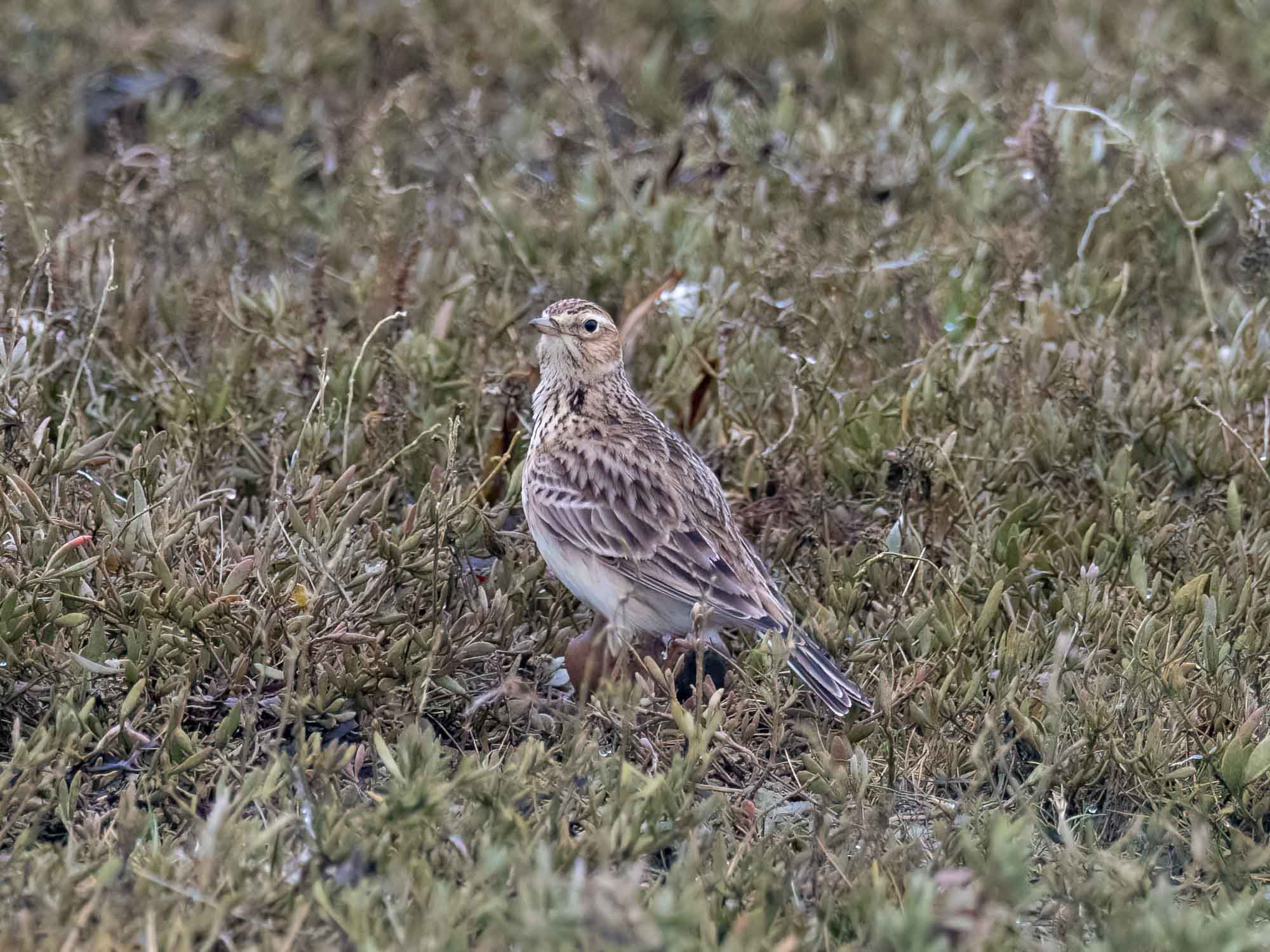
A Skylark flew up from the saltmarsh in front of me and uncharacteristically it soon landed and I managed a few photos.

Skylark

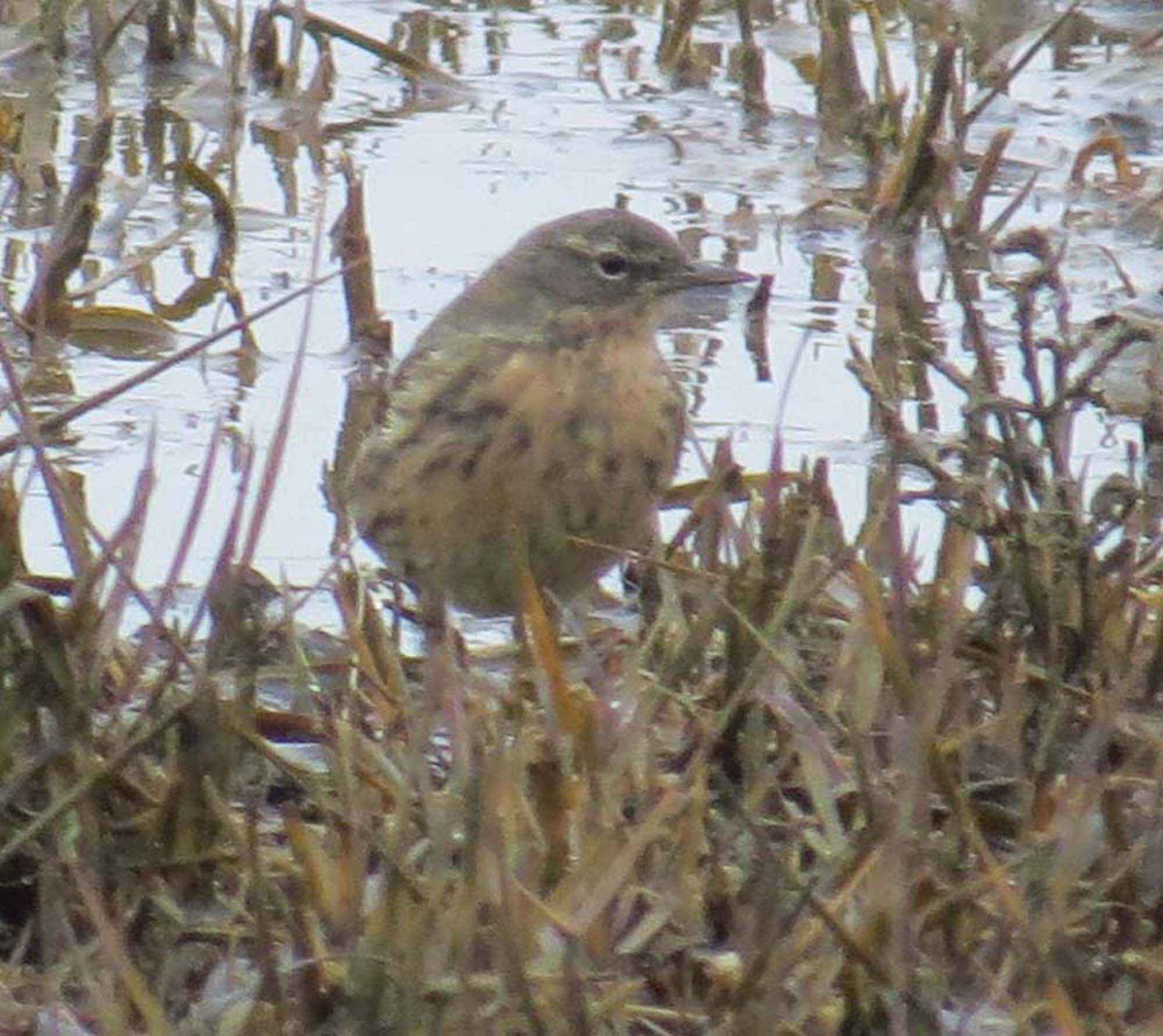
The highlight of the day was the pipit which also lifted up from this area. Even in flight I could see a pinkish wash to the chest and breast. It landed and I had brief scope views, the head was bluish and the supercilium was whitish, this was a nicely marked littoralis Scandinavian Rock Pipit. I’d seen several Scandinavian birds at the Sailing Club on the 3rd November 2021, this could be a bird that has wintered here and is now acquiring its summer colour.

littoralis Scandinavian Rock Pipit photo by Mike Rafter

In the autumn, migrant Rock Pipits of the subspecies littoralis arrive from Scandinavia. They can be very difficult to separate from the British petrosus race but the location of wintering Rock Pipits can help with assigning to race. Rock Pipits seen on the shoreline or a rocky coast are almost exclusively the nominate petrosus birds some of whom breed in Hampshire, Hurst Castle for example. Rock Pipits encountered on saltmarsh, however, like here are good candidates for the littoralis race.

I was frustrated not to get a photograph but thankfully Mike also saw the same bird and had better luck. This individual may well be the same Rock Pipit I have seen near Mary Monts on several occasions throughout the winter but only now is it assignable to race with its pinkish breast and bluish head.

Highlights February 2022

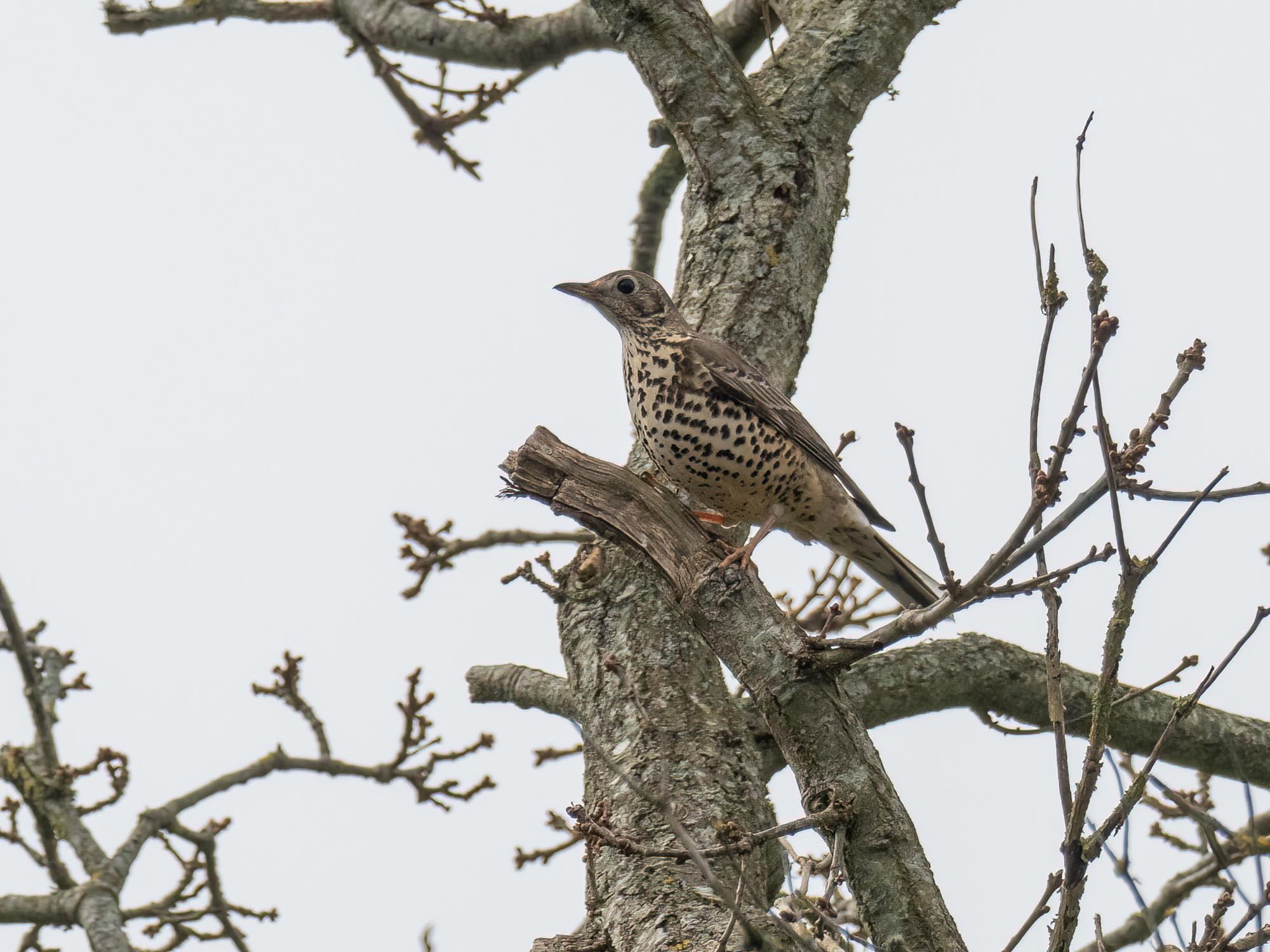
The wintering female Scaup was last seen on the 1st completing a 14 week stay on Black Water. At the turn of the month she was accompanied by building numbers of Tufted Duck which peaked at 32 on the 7th. Good numbers of Mistle Thrush also moved through the reserve on the 7th.

Mistle Thrush

The Avon Valley colour-ringed Redshank was seen again early in the month on Sluice Gate Saltmarsh.

colour-ringed Redshank

Later that afternoon a Common Seal was resting on the river bank south of the Yacht Club. They are well known for hauling up on beaches and sandbanks in tidal estuaries but despite their name they aren’t as common or widespread as the more familiar Grey Seal.

Common Seal

Two Slavonian Grebes remained throughout the month, down from five in January, perhaps some have moved on already, last year they had all gone by mid-March.

Slavonian Grebes

The wintering Spotted Redshank was elusive. I saw it well at De L’Orne on the 10th and then heard it again on the 12th.

Spotted Redshank

The flock of 120 Golden Plover on De L’Orne Scrape on the 12th was the highest count at Needs Ore for five years. There were still at least 80 around at the end of the month.

Golden Plover

The sea was quiet throughout the month in Hampshire and it was the same here. Highlights were a Common Scoter and a Great Northern Diver both heading west on the 12th and 11 Eider also heading west on the 17th. A nice surprise was watching a Great White Egret pay a brief visit to De L’Orne on the 12th

Great White Egret

I didn’t walk the spit during February but managed to see the Purple Sandpiper distantly in the high tide roost opposite the cottages on the 17th, also on the 17th a Chiffchaff was calling in the hedge near Rye Errish Copse on Park Lane.

Pale-bellied Brent Goose (left)

An unexpected Sandwich Tern was off the Sailing Club on the 27th. There have been a handful wintering in the county this year but none were seen here until now.   

Sandwich Tern

There were noticeably fewer Teal on the reserve by the month end suggesting that some are already heading back to Scandinavia and northern Europe. The WeBS count found only 146 compared to 631 in January and 926 in December.

Red Admiral

Several queen Buff-tailed Bumblebees and Red Admirals were seen towards the end of the month by which time birds were establishing territories and plenty were singing. Meadow Pipits in their parachuting display and Skylarks rising into their song flight. Around the water bodies Little Grebe were singing.

Skylark

Birds present throughout the month included the adult Spoonbills with the peak of 17 on the 17th.

Spoonbills

A three year old male Marsh Harrier was seen regularly throughout the month and may be old enough to breed this summer. There was breeding activity around Black Water last year but this may have been younger birds practicing. They did breed locally (east of Lepe) and several juvenile birds visited us in the late summer.

male Marsh Harrier

The two Cattle Egrets were still present at Park Farm throughout February.

Cattle Egrets

Returning Avocet numbers rose steadily to 21 by the month end. They included two colour-ringed birds – AX a four year old ringed at Great Marsh in 2018 who appeared to spend the summer at Titchfield Haven last year, it will be interesting to see if it stays longer this year. Also VI a three year old ringed at Great Marsh in June 2019. It wasn’t old enough to have bred last year but it may well this year. All the Avocets were on De L’Orne Scrape or the river, they don’t tend to visit Great Marsh regularly until April.

Notable absentees include Dartford Warbler not seen or heard since 19th January and still no sign of either adult Peregrine at the Point. It’s been nearly three months since I saw either of them although an adult at Park Shore on the 12th may have been one of our birds.