I set up the moth traps near Pullen Scrub on Saturday night as it was warmer than it had been for a few days. On site it did seem pretty windy and when I returned to check the taps the next morning it also felt pretty cold. I recorded 13 individuals in the two traps, the number of moths was probably affected by the cooler temperatures.
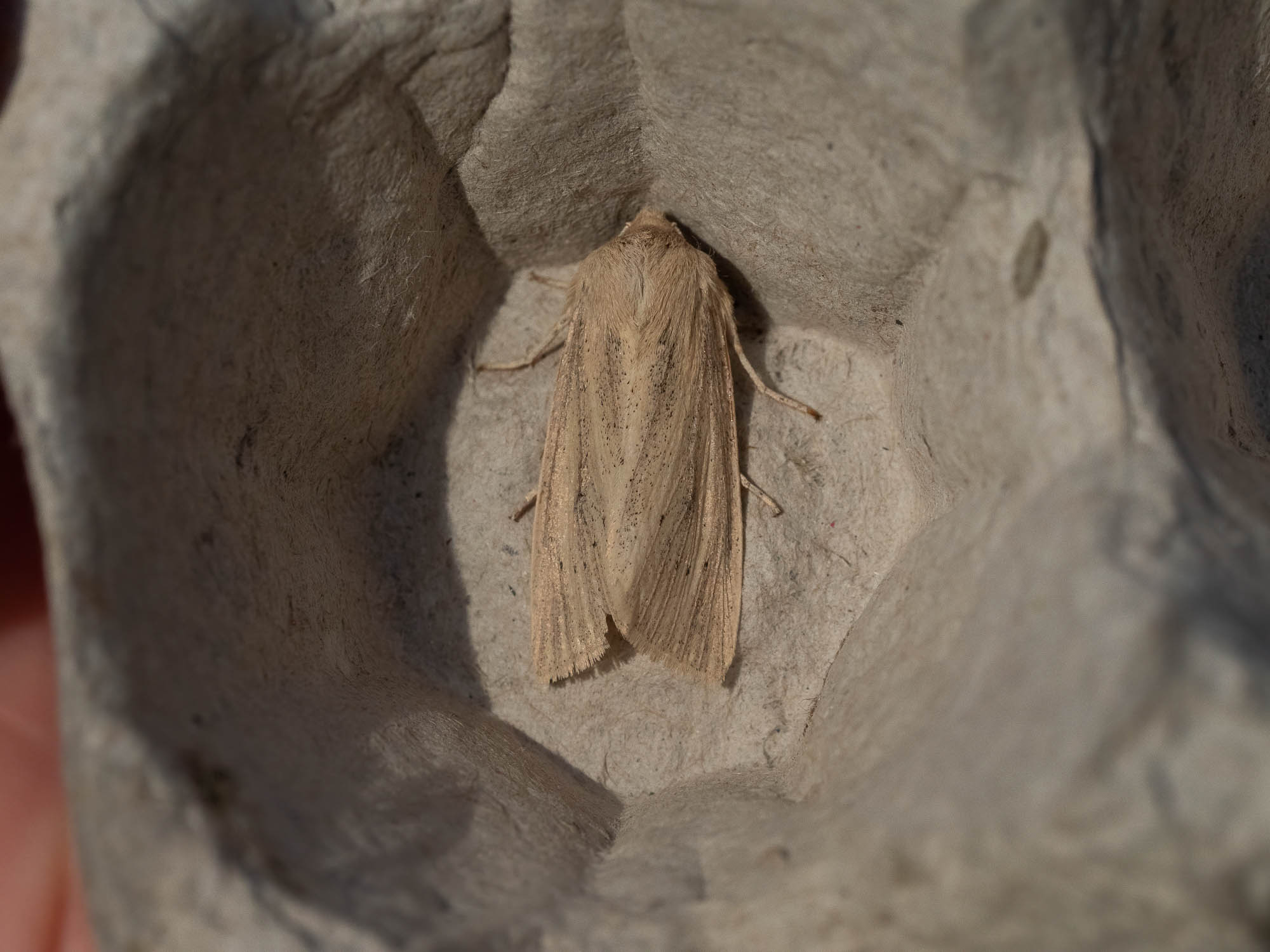
They included four Streak and a Yellow-line Quaker both of whom were last recorded on the reserve in the 1980s, an indication of how little moth trapping, or at least late autumn trapping, has gone on here.
After the moths I walked out along Warren Shore as this stretch needs to be walked regularly as part of avian flu checks. I was also hoping for a Snow Bunting as there have been a few in Hampshire recently. No luck. Five Skylarks and close up Turnstones were the highlights. Amazing to think that these familiar birds come all the way back from Greenland to winter here. This individual is an adult I think judging by the adult type broad fringed covert feathers.
adult winter Turnstoneadult winter Turnstone
I then headed over to Inchmery to meet Ian for the WeBS count. Highlights were two Spoonbill, 46 Pintail on Venner, 587 Teal and six Bar-tailed Godwit on Inchmery.
After WeBS I headed over to Park Shore. The Cattle Egret group was down to three although Dave later saw another two at Park Farm. A Razorbill lifted up from the sea and headed back east towards Needs Ore.
Kestrel
It’s difficult to count Meadow Pipits when they’re feeding in wet meadows but when they lift up and all land in a long line on a barbed wire fence it’s a good chance to count them and check for anything rarer. There were 22. A decent count of 10 Snipe were also feeding on one of the larger inland pools on Park Shore.
A very frosty start with thick ice on the car windscreen. From Warren Shore visible migration in small numbers included Siskin, Linnet, Goldfinch, Song Thrush, Skylark, Chaffinch and Meadow Pipits.
There were two Dartford Warblers in the Beach Gorse, both were elusive but I managed a photo of the first bird, the one nearer to Shore Hide.
Dartford Warbler
As I approached Mary Monts Pools I glanced towards Pullen Hide and a ring-tail Hen Harrier appeared. I managed a brief photo as it headed purposefully over Gravelly towards Park Shore. Only the second Hen Harrier I’ve seen here.
ringtail Hen Harrier
Sea watching was quiet on a flat calm sea with a female Common Scoter being the only highlight.
On Great Marsh 10 feeding Redshank was an unusual sight and there were 2 Rock Pipits near the groynes on the Park Shore side of the beach house. A lovely pale Stonechat perched up nicely in the morning sun and showed that it was ringed. Graham could read enough of the ring to know that he ringed it on 25th September, interesting to know that it may have decided to winter here. This is a 1st winter female, the narrow pointed tail feathers are retained juvenile feathers and you can see that the greater coverts and tertials are fresh while the alula, primary coverts and primaries are older duller juvenile feathers.
1st winter female Stonechat
A pair of Redpolls called as they headed over the Nightingale Enclosure. Back at Shore Hide I noticed Dad’s car and so I headed over to the hides to hopefully meet him. On the way I popped into Black Water hide where three Pochard were newly arrived, the number of Shoveler had increased to 85 and the female Scaup was still present.
1st winter female Scaupadult drake Shoveler
I met Dad at De L’Orne. There were still six Greenshank on the scrape. A Spotted Redshank on the Lagoon had gone unnoticed until it called in alarm as a Marsh Harrier drifted over. It flew over to join the Greenshank near the Roosting Stones. The Greenshank looks like a 1st winter bird showing worn and plain coverts with a brown basic colouration and with a single adult-type grey greater covert.
1st winter Greenshank
It was high tide and there were good numbers of other waders on the scrape including 220 Dunlin, 108 Ringed Plover, five Black-tailed Godwit, six Avocet and a Grey Plover. From the hide I watched a male Red-breasted Merganser fly up the Beaulieu River.
An adult Redshank fed on the saltmarsh opposite the sluice gate. 1st winter birds would show buff-fringed scalloped coverts and notched dog tooth tertials. This adult has whitish edged coverts, pain tertials and bright red legs.
adult Redshank
We headed over to the Sailing Club where the number of Brent Geese had grown. I counted 330 but many more were probably hidden from view. Of the 40 or so that were close enough to age easily there were only two juvenile birds, not a great return. The juvenile birds will keep these white-edged covert feathers until they moult in the spring.
Brent Goose family, two adults and two juvenilesjuvenile Brent Goose
Almost all the wildfowl on the river suddenly flew up noisily and we soon found one of the White-tailed Eagles perched on a bare tree at the bottom of Exbury Fields.
Three pipits called confidently and in flight they looked larger and less hesitant than the familiar Meadow Pipits. I checked the three Rock Pipits and one was slightly different and probably a Scandinavian Rock Pipit sub species littoralis. The white outer tails feathers exclude petrosus race Rock Pipit.
Scandanavian Rock Pipit littoralisScandanavian Rock Pipit littoralis
Nine Snipe flushed up from the shoreline along the River Outflow Channel.
I headed over to Park Shore and walked the beach to the Beach House. I was hoping for a Short-eared Owl but I was pleased to see a male Merlin dashing away from me very low over the fields. The Great White Egret appeared briefly in the distance and dropped down in the fields near the Reedy Ditch. One of the White-tailed Eagle appeared in the same direction.
It was now low tide and several Grey Plover and a Knot were feeding on the stony beach.
Knot
On the way back to the car I had site high counts of 22 Collared Dove and 31 Egyptian Geese.
Egyptian Goose
The cattle had been moved to the very last field at the top of Park Lane and the six Cattle Egrets had moved with them. Graham has suggested that they may winter here as although the dairy herd will soon be going indoors for the winter 80 heifers are going to continue to graze the fields.
I headed to the beach first. Sea watching was a little quiet other that a steady stream of gulls heading west. As on Thursday it was mainly Black-headed Gulls with a few Common Gulls, Mediterranean Gulls and Herring Gulls.
The highlight of the sea watch was a pristine black and white Razorbill heading east. I’ve seen auks on all of my last three visits which is amazing although I heard recently that the east coast was seeing lots of auks close inshore with many dying from starvation. I hope that this isn’t the reason for the recent spate of auk sightings here.
The only other birds of note were 17 Pintail appearing from mid channel and then heading towards Black Water. I checked the busy flock of 17 Turnstones, perhaps they may include a Purple Sandpiper one day.
The clearance and enlargement of the flood just to the west of the boardwalk has created a bare area of ground which attracts Meadow Pipits and Pied Wagtails.
Meadow Pipits
A group of Reed Buntings perched nicely near the Viewing Gate. In their post juvenile partial moult Reed Buntings often replace all of their coverts and tertials (as well as their body feathers) and so there is little moult contrast in the wing making it difficult to age them. However, their tail feathers are usually retained and so are the typical pointed and worn juvenile feathers as shown by the bird pictured below, which is therefore a 1st winter individual. The body moult will include adult head feathers and so the lack of black feathering here also mean that this is a female.
1st winter female Reed Bunting
There were lots of Blackbirds and Robins around, no doubt many of these will be migrants. This Robin shows the pale tips to the greater coverts and the pointed tail feathers of a 1st winter.
1st winter Robin
Over on De L’Orne Scrape 161 Lapwing were roosting strung out along the islands. Last year numbers really started to build from early November peaking at 601 by the end of the month. A Spoonbill lifted up from somewhere nearby and circled back around and landed on the scrape, my first for nearly three months.
adult Spoonbill
A pair of Tufted Duck were on Venner, the first I’ve seen since the breeding female left with her seven off spring in late August. Black Water was full of Shoveler, 55 in total, with them spread out right across the water. The female Scaup was still present although favouring the right hand side where the water is deeper.
adult drake Shoveler
I stopped at the Reedy Ditch hoping for a Short-eared Owl but no luck.
On Wednesday, while leading a group of birders Graham found a female Scaup on Black Water. Dimitri was nearby and saw it as well. Both Graham and Dimitri messaged me to tell me about the bird.
I was originally planning to visit on Saturday but with the arrival of the Scaup and the fact that the weather wasn’t great on Saturday I decided to head over to Needs Ore early Thursday morning. I met Dimitri at Shore Hide and we headed over to Black Water.
In Black Water hide I quickly picked out the Scaup. Being a night feeder it was asleep for most of the time. Larger than the Wigeon and similar sized to the Shoveler, the broad chest and large rounded head were obvious with no sign of any tuft and an obvious and extensive whitish blaze. I think it is probably a first winter female based on the browner body, reduced black nail on the bill tip and the less extensive white blaze particularly above the bill.
1st winter female Scaup
Scaup are some of the most maritime of all the ducks that visit us, the nearest breeding populations are Norway and Iceland. Most of the wintering birds around the UK are coastal but smaller numbers can be found on lakes and reservoirs. Ringing recoveries suggest that most of the UK wintering birds are from Iceland.
1st winter female Scaup
In the past we have had one or two Scaup turn up on Blackwater in the autumn and they have stayed around for several weeks or even months. There are usually around 10-20 in Hampshire in a typical winter. Most of the Shoveler on the reserve are concentrated here and so it was worth a quick count, there were at least 52, with 11 Pintail mixed in and a single male Pochard.
Pochard photo by Ian Williamson
Migrant Hawker and Common Darter were around De L’Orne and a Clouded Yellow flitted across in front of De L’Orne hide and settled in the grass.
Clouded Yellow
The 24 Cormorant on Venner Island is my largest site count.
Cormorant
We headed back over Warren Lane to watch the sea at Mary Monts. A confident and bulky Rock Pipit called overhead before landing on the shingle beach. After a close Razorbill on the sea on Saturday I picked out a Guillemot also resting on the sea.
Guillemot
Large groups of Black-headed Gulls were loitering off shore in loose fishing flocks with a handful of Common Gulls and one or two Mediterranean Gulls. Dimitri picked up two White-tailed Eagles over the Isle of Wight and both of them headed over the channel towards us and then headed towards the Black Water area.
White-tailed Eagle male G393 photo by Ian Williamson
On the way back to the car we picked up a Dartford Warbler at the Shore Hide end of the Beach Gorse, calling regularly but it didn’t show in the breezy conditions. At the Sailing Club 13 Little Egret and 14 Cormorant were engaged in a cooperative organised chase up the river edge herding and chasing fish.
Little Egret and Cormorant photo by David Cuddon
The Little Egrets were high stepping along the edge of the river with occasional wing flicks while the Cormorants were swimming low and fast in the water alongside them.
Little Egrets
Four Black-tailed Godwit were feeding on the river edge towards De L’Orne and the adult male Pied Wagtail was hanging around the Sailing Club, it’s presumably one of the two adult birds who raised two broods in the eaves here.




 Patch Birding