birds

Monday 10th January 2022

I headed off extra early to try and find a Woodcock feeding before dawn, it was warm and so the ground wouldn’t be frozen. I’d seen one last winter, using my thermal camera, feeding at the back of Long Pits. I thought I’d try that field again this morning. I parked up at 6:50am and although it was pitch black I immediately picked up a thermal outline of a suitably sized bird about half way across the field. I find it difficult to identify individual species by their thermal signature but in flight identification was pretty straightforward and as soon as I set the video going the bird flew and I could instantly see that it was a Woodcock. It flew into the woods where they spend most of the day hiding in the leaf litter.    

Woodcock at Long Pits

Having found a Woodcock so quickly I used the time I’d saved to try an area that has previously held Little Owls. As soon as I got out of the car I was delighted to hear the mournful call, it was 7:10am.

Little Owl calling

After making a brief recording I headed back to the Reedy Ditch where a Barn Owl was quartering over the reeds towards Park Shore. Apart from a Barn Owl near St Leonard’s Barn on 6th February 2021 this is the first Barn Owl I’ve seen hunting at Needs Ore. The owl was quartering at 7:40am which is 25 minutes before sunrise.

An early morning stop at the Reedy Ditch is often good for passerines and so I walked up and down Warren Lane from Black Water House to the Paddock, I was hoping for Marsh Tit, Coal Tit, Firecrest and Treecreeper. It was really quiet and I didn’t see or hear any of these species although I was delighted to see a Glossy Ibis flying over at 8:30am. It was still fairly dark and I needed ISO 5000 to achieve the 1/2000 second shutter speed required for flying birds.

Glossy Ibis over the Reedy Ditch

Up to three Glossy Ibises have been seen on three separate occasions over the last 10 days, each time flying over the Reedy Ditch between 8am and 9am. They then appeared to head towards Park Shore, it was the same today and so I planned to scan the fields at Park Shore when I was over there later. Soon afterwards seven Little Egret arrived from their roost site somewhere to the west. A Green Woodpecker called regularly while I was at the Reedy Ditch.

Bullfinch

After the Reedy Ditch I parked at Shore Hide and walked back along Warren Lane before turning left at Cattle Grid corner. Along Warren Lane I was hoping to see the Firecrest that Ian had seen from the Pullen Gate layby, but no luck today. I then headed to the beach for sea watching.

When the wind is very light the sea is calm and it’s much easier to see at a glance if there is anything on the sea. Sometimes that just means it takes less time to see that there’s not much! However, today was pretty good with two Slavonian Grebes beyond the cottages and a total of four Razorbill and two Guillemots. Not sure why but still no Great Northern Divers this winter. As I was leaving a Dartford Warbler called from the bushes and I saw another one almost back at the Shore Hide between the toilet building and the water trough.

Over at the hides the scrape at De L’Orne held around 100 Lapwing, 12 Avocet, 13 Spoonbill and 20 Shelduck. Nigel had mentioned there being Otter spraints on the boardwalk, I may set up a trail camera to try and get some footage.

Otter spraint

Over on Black Water 19 Tufted Duck of which 11 were males is the biggest count I’ve had at Needs Ore and it’s the biggest count by anyone for almost 4 years. The female Scaup was accompanied by four Pochard and a Great Spotted Woodpecker was calling over the back of the water.

Tufted Ducks

At the Sailing Club the juvenile/1st winter Peregrine was on Gull Island but again no sign of either adult birds. Perhaps they may have abandoned the site after two consecutive failed breeding attempts. Several waders landed close to the launch and so I crept closer using the wooden raised area as a hide. Ringed Plover show a white supercilium, short rear end, two tone bill and brighter legs, all of which separate it from Little Ringed Plover (and also a wing bar and a different call). Little Ringed Plover also wouldn’t be here in the winter or in this habitat. You can also see that the darker ear coverts meet the bill at the gape line and not above like it does with Semipalmated Plover.

Ringed Plover

Some waders have the ability to selectively bend their bills, the final section of the upper mandible can flex upwards independently of the rest of the bill. This action opens the tip of their bill wide enough to seize prey, even while buried deep in mud or wet sand.

Dunlin flexing bill tip

I headed off to Park Shore and soon after I’d arrived at the top of Park Lane I heard a familiar ‘hu-et’ call and later in the small copse of trees north of Rye Errish House I found two wintering Chiffchaffs, my first on the reserve. The call sounded like a classic western European collybita however I managed photos of one of the birds which didn’t call and it looked strikingly grey beige lacking a green tinge on the crown and mantle and lacking a yellow tinge on the supercilium and breast. It may be one of the eastern races perhaps tristis Siberian Chiffchaff although it would be good to return for better photos and hopefully a recording of it calling.

probable Siberian Chiffchaff

Also in this small group of trees a lovely Firecrest showed well along with two Goldcrests and a Treecreeper which I heard but didn’t see.  

Firecrest
Treecreeper calling

From the panoramic viewpoint next to Errish House I could see that the two Cattle Egrets were still keeping the horses company on Park Farm. I scanned the fields from the viewpoint but I couldn’t see the Glossy Ibis.

birds

Thursday 6th January 2022

A ninety minute flying visit to walk the spit and check what was happening on the sea. The 1st winter Purple Sandpiper, the second ever at Needs Ore, was still feeding happily on Warren Shore opposite the cottages.

1st winter Purple Sandpiper

A reasonably close Razorbill and a single Slavonian Grebe were drifting west on the falling tide, six Eider headed east and seven Red-throated Divers flying west is the highest ever count at Needs Ore.

Razorbill

A Peregrine was perched on Gull Island, too far away to be sure if one of the adults had returned or whether it was the regularly seen immature bird. A White-tailed Eagle headed in off the sea as I was getting back to Mary Monts. A noticeable influx of Redwing with at least 25 on Droveway South and 10 on Warren Farm Fields. 

When trying to age the Redwing I was uncertain as there appeared to be contrasting clues:-  the tertials look adult-like, without white triangles at the tips, and the primaries look new and fresh. However there does appear to be some moult contrast in the greater coverts and the tail looks a little spiky. I asked Graham and he commented that the tertials and tail feathers are difficult to make an assessment on as it is better to see them from above. However, the greater coverts do show that it is a first-winter (hatched last summer).

1st winter Redwing

“If you look along the greater coverts, roughly half way along there is a sudden difference in the length and colour of the tips of those feathers, indicating a clear moult limit. Several of the inner greater coverts (the ones to the left) have been moulted, but some outer ones (the ones to the right) have been retained and these are the shorter juvenile feathers with pale tips, as opposed to longer buttery-brown tips of the adult-type greater coverts. An adult would have moulted all the greater coverts and therefore they would be uniform”

For the same reason I think the greater coverts on the following Redwing make it an adult

adult Redwing
birds

Wednesday 5th January 2022

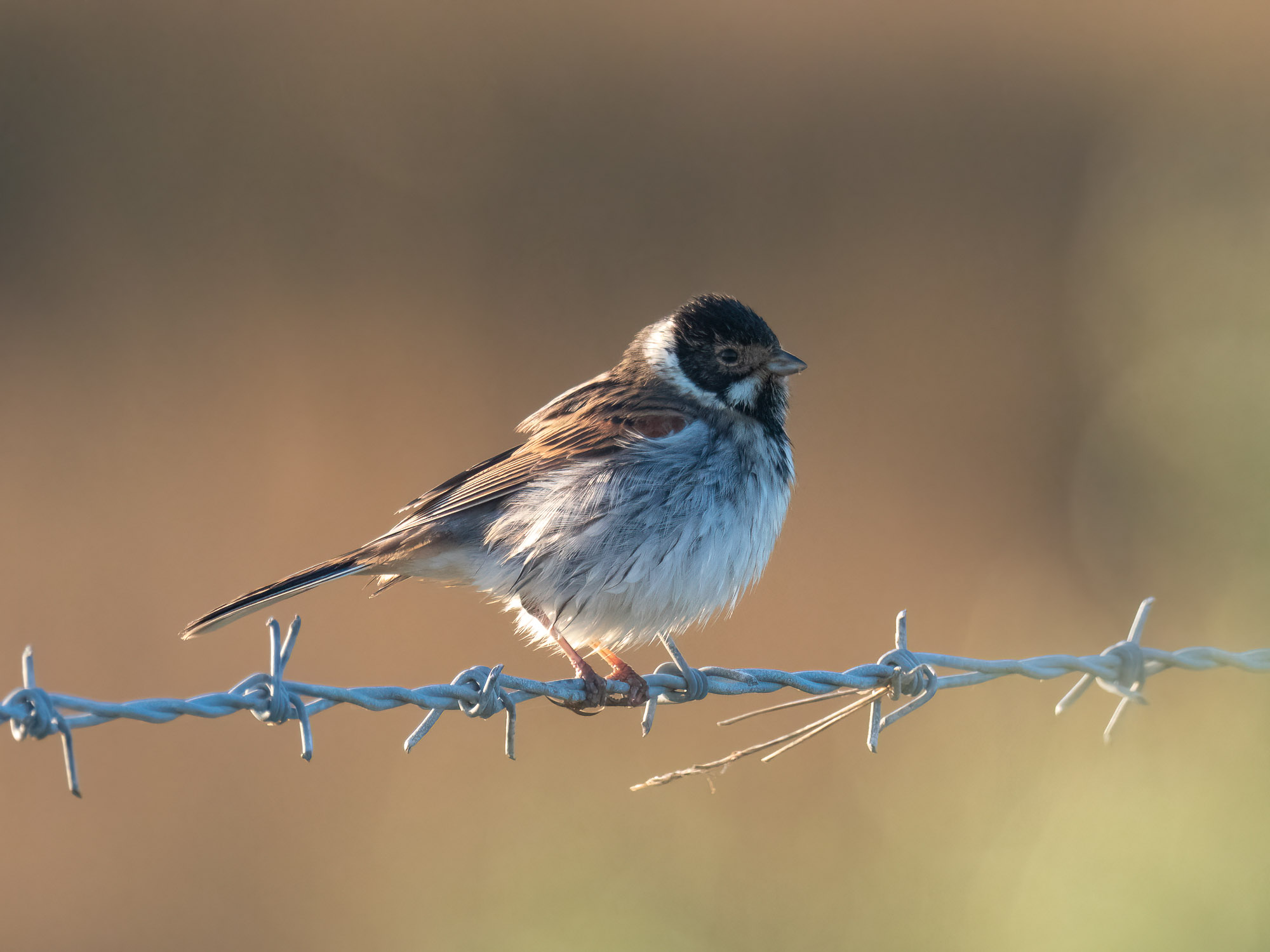
I met up with Dad for the day. On the way to the beach a Reed Bunting showed really nicely in the early morning sun. This adult male is moulting into breeding plumage by wearing away the brown-fringed head feathers to reveal the blacker colours below.

adult male Reed Bunting

On the sea a single Slavonian Grebes drifted off shore and a distant Red-throated Diver appeared briefly but was then elusive. I later saw the diver again, it had drifted almost the full length of the Isle of Wight towards Lepe on the rising tide. Even at long range the up-tilted bill and slender flat chested appearance were obvious. Five Red-breasted Mergansers headed west and a single Razorbill was sat on the sea out from the cottages.

A Dartford Warbler was calling again from the bushes near Mary Monts. There aren’t as many individuals as last winter, perhaps three or four this year compared to maybe six or seven last year.

1st winter Little Egret

De L’Orne was fairly quiet with rising numbers of Avocet, now 17, and a single Spoonbill. The highlight of the day was managing a decent photo of a Cetti’s Warbler, a difficult species to see well. They do sometimes appear on the edge of the reeds, cocking their tail and showing well for a few seconds, thankfully we were ready in Venner Hide. You can see the long, dark centered and pale tipped undertail coverts. You can even see that Cetti’s Warblers have only ten tail feathers and also very short primaries typical of short range migrants.

Cetti’s Warbler

A Jay flew along Warren Lane, one of the common species we missed on Saturday’s bird race. We headed over to Park Shore to see if we could find any Crossbills. They start getting active much earlier than other breeding birds and I’d seen and heard them in December and January last year in the small pine copse at the top of Park Lane. No luck today. It’s also a good area for Coal Tit here but again no luck. Thankfully the Cattle Egrets were still around Park Farm although the cattle appear to have been taken in now. The egrets were hanging around the horses near the farm. This one showing just a hint of summer plumage on the crown.

Cattle Egret

In the grassy fields on the walk to the beach there were at least 25 Redwing and off shore there were another two Slavonian Grebes. Three Mediterranean Gulls were roosting on the sea with the Black-headed Gulls

Redwing

After Dad headed home I decided to walk the spit however with the tide at 2.8m there were still waders roosting and the tide was still close to breaching the shingle close to Teal Point. On a falling tide the saltmarsh inside the shingle beach is also flooded to a greater degree than the same height of tide on a rising tide. This is presumably because the saltmarsh holds water temporarily even as the tide falls. In any case I decided that there were too many wildfowl using the saltmarsh and too many waders roosting on the spit for me to walk out.

Instead, I walked to the cottages and looked through the wader roost from there. 112 Knot was my highest count to date although I noticed that more than 400 have previously been recorded on WeBS for ‘Beaulieu/Lepe’. I’m not sure where these birds roost.

birds

Saturday 1st January 2022

Just like in 2021 Ian and I attempted to see as many species as possible around Needs Ore on New Year’s Day. Last year I saw 81 and this year we seemed to be well ahead of track all day and I finished with a roosting Kingfisher along the ditch near the sluice gate. I saw 97 species which is amazing and makes me think that 100 may be possible next year especially as we missed Coal Tit, Marsh Tit, Jay, Firecrest, Eider, Great Northern Diver and Treecreeper.

Highlights were three Glossy Ibis found by Ian going over the Reedy Ditch at 8am, also 4 Brambling calling here. Sea Watching produced Kittiwake, Red-throated Diver, Razorbill, Guillemot and Slavonian Grebe. Also the Scaup on Black Water and a Nuthatch calling from Silver’s Copse.

Brambling calling over the Reedy Ditch