Autumn 2021, September 2021

Wednesday 29th September 2021

Another prominent Blackcap and Chiffchaff day with at least 15 Blackcaps of which six were around the sunny bramble bank near Flycatcher Tree. At least 25 Chiffchaffs were scattered around the reserve. There were also lots of Swallows moving through and pausing to feed low over the Flooded Fields and Warren Flash.

Blackcap
Chiffchaff

Jays have become much more visible in September as they’re foraging for and burying acorns but maybe also some migrants moving through. I saw at least four today. A single Raven cronked as it went overhead and one of the Ospreys was again over De L’Orne as I appeared from the end of the Main Hedge.

Osprey

juvenile Marsh Harrier

One of the local juvenile Marsh Harriers drifted low over Black Water before landing in the reed bed opposite and lots of alarm calls and birds in the air alerted me to a Sparrowhawk on the fence posts out from De L’Orne hide.

Sparrowhawk

Only three species of butterfly today, Speckled Wood, Red Admiral and perhaps the most numerous and freshest were the Small Coppers.

Small Copper

It was great to see the White-tailed Eagle, reasonably close over Black Water as Adam, Steve and I attempted to bring in two of the tern rafts. The water levels are still low for this to be possible so we’ll have to try again after some heavy rain. Four Spotted Redshank flew in to De L’Orne lagoon as we were working and a single House Martin drifted overhead.

White-tailed Eagle

I finished with a visit to the Sailing Club to change the AudioMoth bat detector batteries. I analysed the data later and was thrilled to see that a Greater Horseshoe Bat flew past the Warden’s Hut at 11:30pm on the 19th September 2021. This is a significant record for Hampshire and has been confirmed by the Country Recorder.

Greater Horseshoe Bat sonogram

From the Sailing Club there were two Sandwich Terns roosting on the mud towards Inchmery and a reminder that winter is on the way was provided by a Bar-tailed Godwit roosting near the terns, two Rock Pipits by the Sailing Club and 18 Brent Geese in the river mouth.

Rock Pipit
Autumn 2021, September 2021

Saturday 18th September 2021

A very brief visit this morning as I was heading to Slimbridge later to go moth trapping with Peter. I walked to the hides first. There were at least 15 Yellow Wagtails with the cattle in the Wedge Field showing a variation of plumages across ages and sexes.

Yellow Wagtails

You can see the eastern end of Black Water from the side window in the new De L’Orne hide and from here a Little Grebe ventured close.

Little Grebe

Soon afterwards a Water Rail squealed and then dashed across the gap between the reed beds.  

Water Rail photo by Brain Fairbrother

Ten Greenshank flew across the lagoon and a single bird dropped on to the mud in front of the hide.

Greenshank

An over mature female Common Darter landed on the track near Gravelly Crossroads, the darkest one I’ve seen. The lower part of the visible eye is not showing any signs of the bright blue colouration which is a key characteristic of Red-veined Darter.

Common Darter

On the new islands three Snipe and two Little Egrets were resting. Everything went up from the scrapes as one of the Ospreys drifted close to the lagoon, it hovered briefly and then dropped down to the river. It was high tide which was part of the reason why the Osprey was fishing so close to the scrape and also why several waders were also on show, 13 Redshank, 3 Black-tailed Godwit and 3 Dunlin.

Osprey photo by Ian Williamson

A quick stop in Black Water hide produced a silent Spotted Redshank heading over to De L’Orne. A mobile Green Sandpiper moved between De L’Orne flood, the back of De L’Orne lagoon and then on to the muddy fringe in front of the newly cleared NFOC hide.   

Autumn 2021, September 2021

Thursday 16th September 2021

Mist and dew made this morning feel very autumnal. I walked the fence line through the beach gorse and one of the first things I noticed was something caught on the barbed wire flapping and trying to free itself. As I got closer I could see that it was a Convolvulus Hawk-moth, a rare but regular migrant to northern Europe from southern Europe and Africa.

Convolvulus Hawkmoth

It was attached fairly strongly to the barbed wire but it wasn’t caught on the barbs. It was almost as thought it was caught in a spider’s web. I freed it and it seemed fine. I also considered that it might be a shrike larder but it was 6.45am about 3 minutes after sunrise, the moth was covered in dew and in perfect condition. It wasn’t skewered to the barbed wire and so I think it got stuck overnight somehow.

Once I’d freed the giant moth I turned to see a pair of Roe Deer watching me intently through the thick fog.

Roe Deer

There was a large group of noisy Canada Geese offshore with 215 strung out from Mary Monts. Eight nervous Snipe were flushed from the pools.

Whimbrel

Today was a Blackcap and Chiffchaff day with plenty of them on the move and lots of ‘chacking’ and ‘hueeting’ wherever I went. There were at least 20 Chiffchaff fly-catching in the large trees bordering Gravelly Track. On Great Marsh a Sedge Warbler appeared briefly.

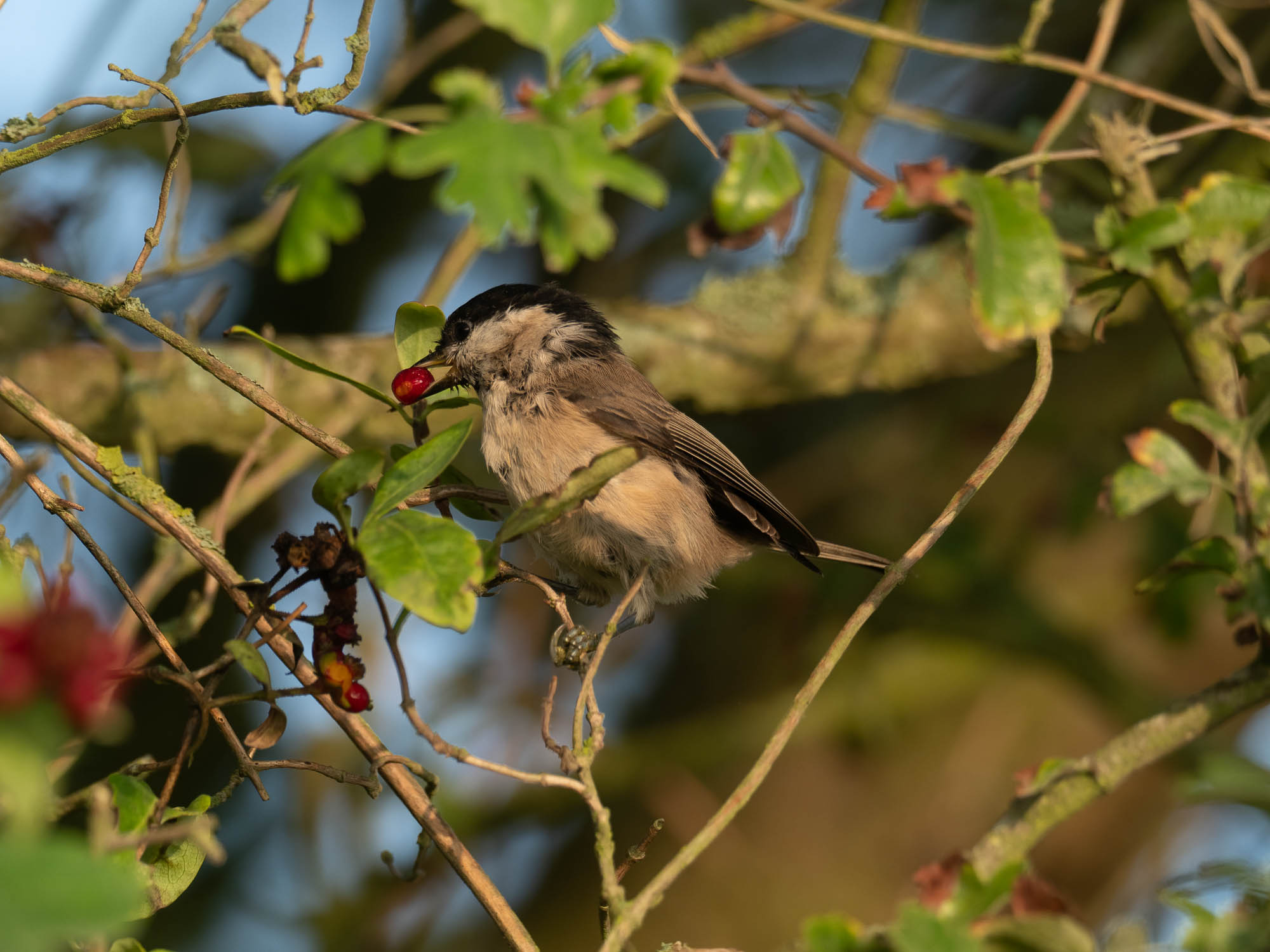
My first Marsh Tit since May was eating berries near the Reedy Ditch.

Marsh Tit

A hirundine flock was assembling on the wires opposite Black Water House. It had become so foggy that it was difficult to tell what they were but there were roughly 275 birds with around 225 of them House Martins and perhaps 30 Swallows and 20 Sand Martins.  

Buzzard

In a hidden clearing of heather along Warren Lane Beach Scrub Ian had found a colony of blue butterflies. It was warm now so I had a look. The Common Blues were pretty fresh but a smaller Brown Argus was very faded, both species are double brooded and they can be seen in late September. Compared to Common Blue the Brown Argus lacks a spot on the underside of the forewing nearest the body and unlike Common Blue and Silver-studded Blue they also have two spots very close together on the hindwing which almost coalesce to look like a number ‘8’. Brown Argus is a patch tick.

Brown Argus photo by Ian Williamson
Brown Argus
Brown Argus
female Common Blue blue form
Common Blue
Brown Argus
Common Blue
Small Copper

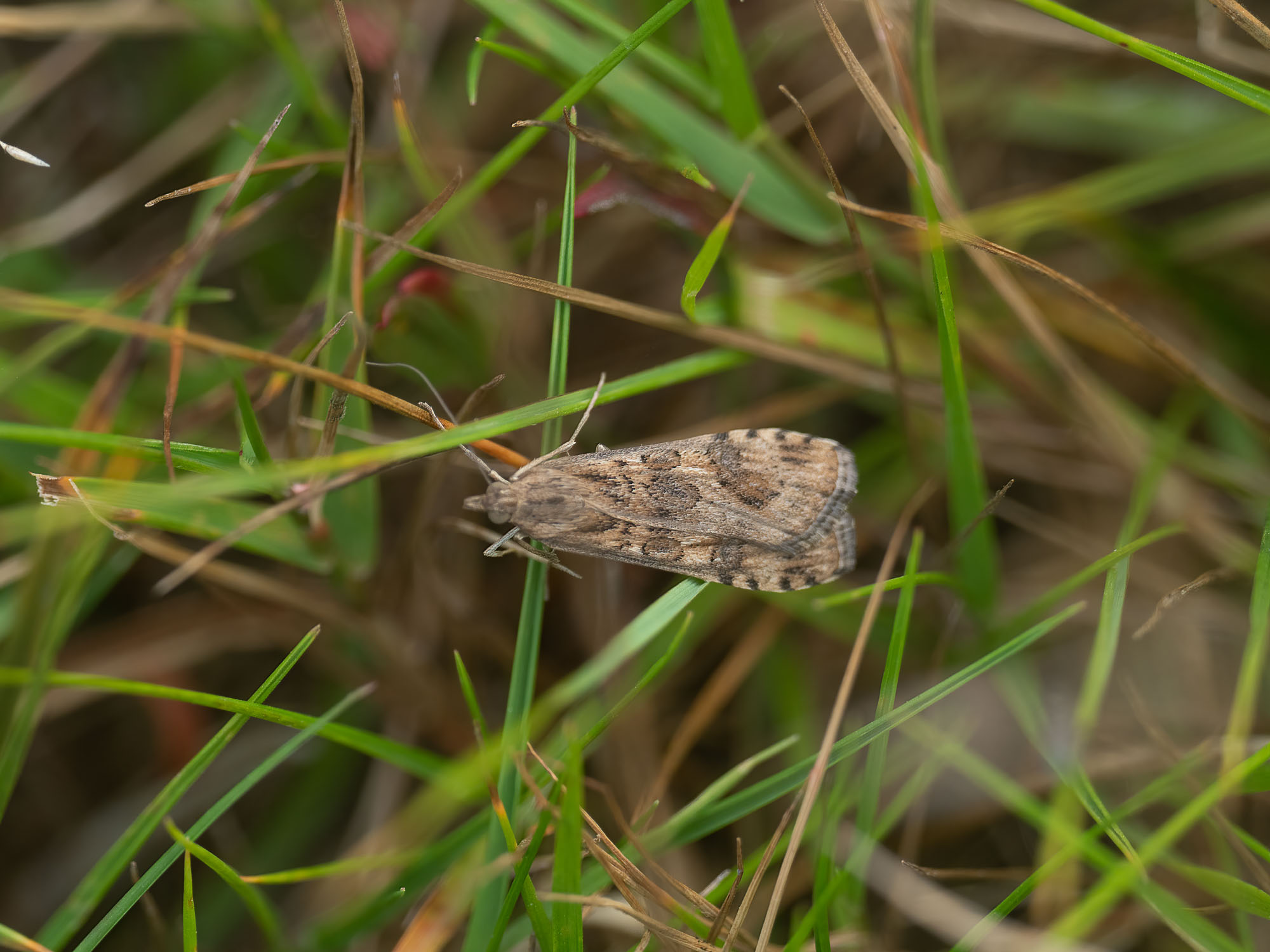
There were also lots of fresh Small Coppers in this sheltered area and a Rush Veneer, a migrant moth which is often found at the coast.

Rush Veneer Nomophila noctuella

I walked to the hides and noticed the Osprey heading over the De L’Orne area. A second Osprey was visible in its normal tree in the Calshot Tower direction.

As I reached De L’Orne hide I could see the Great White Egret stood on the top of the pines at the back of Black Water. After a few minutes he took off and headed back towards the Reedy Ditch area. August and September are good months for new egrets arriving and since the first sighting nearly three weeks ago the Great White Egret has ranged widely from Park Shore and Great Marsh to De L’Orne and most areas in between.  

Great White Egret

The White-tailed Eagle appeared again having been seen returning to the Isle of Wight earlier in the month. He appeared from the Gins East direction and was immediately harassed by one of the Ospreys before landing in the fields on the Inchmery side and then later landing on the saltmarsh opposite the Royal Southampton Yacht Club.

Before heading home I chatted to Alan and Caroline. The Southern Migrant Hawker didn’t appear but while we were talking Alan noticed a Clouded Yellow heading eastwards along the ditch near the car park, only my second on the reserve.

Autumn 2021, September 2021

Sunday 12th September 2021

There was a significant Chiffchaff movement today with ‘hueeting’ and tail pumping birds all over the reserve, at least 50 in total including five in one small bush alone. Blackcaps and Meadow Pipits were also highly visible in good numbers. I reached Great Marsh as the Great White Egret lifted up from the scrape.

Great White Egret photo by Ian Williamson

There were several loud and low flying Yellow Wagtails and having patrolled the private areas around Gravelly Marsh I decided to walk from the Gravelly cattle grid to Flycatcher Tree north of the Reedy Ditch. In the Droveway opposite Black Water House a Garden Warbler appeared briefly and several Chiffchaff were fly-catching in a sheltered spot opposite.  My first Treecreeper for a while appeared nearby.

Chiffchaff

A Redstart was feeding and moving along the hedge bordering Droveway North gradually moving closer to the dead trees at Black Water Farm. All along the hedge line it would drop down into the field looking for insects, it did this at least four times.

Redstart

A single Reed Warbler at the Reedy Ditch is getting quite late now. They had a good breeding season with lots of juveniles around and at least two broods. A singing male was the first long distance migrant of the year back on the 1st April at Black Water. It definitely feels like the changing of the seasons when the last of them departs again. 

There were good numbers of Wheatears today with at least ten seen.

Wheatear

Next I wandered over to the hides where one of the Ospreys was hunting over the De L’Orne area. A single Whinchat was on the furthest post along Whinchat Fence.

High tide was at 3:40pm and so we headed over to Inchmery for my WeBS count. This month Ian and I are doing the two sectors together so that he sees my routine and I can see his, this will be handy if we ever need to cover each other.

At Inchmery highlights were building numbers of Oystercatcher and Redshank, 110 and 81 respectively before a juvenile Osprey flew right over our heads flying purposefully on to Lepe. Later a second individual was seen catching a fish off the Warden’s Hut. The splash was visible from our position nearly a mile away.

Osprey

We headed back to Needs Ore to complete Ian’s sector. The Great White Egret was in the Reedy Ditch but took off as soon as we got out of the car, it eventually landed on the river beyond De L’Orne. On the walk over the flooded fields a young Hobby dashed over the boardwalk chasing Meadow Pipits. One of the Ospreys had caught another fish and had settled on the fence posts which run directly away from the new De L’Orne hide.

Osprey

The flood area which spills over from De L’Orne lagoon towards the boardwalk has been good for waders and today a major highlight was finding nine juvenile Ruff feeding together, one of the highest Hampshire counts in recent years. One of them was much smaller and raised the heart rate temporarily although it proved to be a small female. I’ve been visiting Needs Ore for a full year now and Ruff is the 175th species I’ve seen. A stretching year list target for future years.

Ruff photo by Ian Williamson

Other highlights on the WeBS count included building numbers of Wigeon and Teal, 51 and 379 respectively, most on Gins East. Also 20 Pintail and a Jersey Tiger.